Showing posts with label animal stories. Show all posts

Friday, November 7, 2014

Blog Tour: I'm My Own Dog, by David Ezra Stein (Candlewick, 2014)

It's a special pleasure to welcome to the Fourth Musketeer author/illustrator David Ezra Stein.  David is the creator of many award-winning picture books, including Interrupting Chicken, which was awarded a Caldecott Honor, and Dinosaur Kisses.  His books are great read-alouds, and are favorites of librarians, teachers, parents, and yes, kids.  

He has kindly agreed to answer a few questions about his very funny new picture book, I'm My Own Dog.  In a role reversal that will tickle all dog lovers, this dog has no need of a human owner.  He can perfectly well take care of himself (except for that one little spot he can't scratch).  But what will happen when he lets one of those cute humans follow him home?  Kids and adults alike will love the reversal of roles in Stein's newest book.  

Q:  David, my miniature poodle Buddy would love your new book--if he could read.  He definitely thinks he's in charge of the house and will even carry his own leash and throw toys to himself in play and then run and fetch them.  Was there a particular dog that inspired you to create the character in I'm My Own Dog?

my dog, Buddy


A:  Hi Margo! Maybe he can read, but doesn’t want to let on. Even if he doesn’t read English, I’m hoping this book will be translated to Doggish sometime soon. Admittedly, it’s hard to find a translator…. “Woof! Wauf! Wooooah! Wuf. Rrrrrr?” Sorry for the interruption; that was just me asking if there are any dog translators out there. I only speak a little, broken Doggish.

I was not inspired by any one dog, but by my inner dog, I suppose, who wants to be his own master. To be able to choose how he responds to the world, and not be lead around by a leash of fear or knee-jerk reaction. That is a kind of mastery. That is a dog who walks himself.


some examples of Stein's humor and artwork
Q:  Who are some of your favorite fictional dogs, either in children's or adult literature?

A:  Harry the Dirty Dog.

Q:  Could you discuss a bit using animals or monsters as protagonists in children's books instead of actual children?  I've always wondered if this decision was made in order to avoid having to choose a specific race if children were used, or is it really just because it's much more fun to draw chickens and dogs than kids?  

A:  Sure. I don’t know that there’s only one answer to this, but it does seem to me an animal or monster or whatever non-human character we employ in literature, is used to give a higher degree of universality. Kids tend to be open to animals in a way that they are not open to people.
It is perhaps easier to achieve a timeless quality using non-humans, because you can circumvent the trappings of fashion, technology, etc.

And yes, I do think it’s effective to use animals when it comes to race and even gender, in that it helps focus on the subject matter, and I think it is more relatable for all children.
Additionally, although we live mainly in cities, there is still an archetypal wilderness inside each of us, populated by wolves, bears, rabbits, owls, snakes, and such. Whether this stems from Fairytales, or Aesop’s Fables, or much deeper times when we ourselves lived in the woods, I don’t know.

Lastly, from an illustration standpoint, it is more fun to draw creatures or animals. I am not that into drawing kids, for some reason. Animals and monsters and such can be designed to an extent that allows for a lot more leeway.

David, thanks so much for visiting The Fourth Musketeer!  I look forward to reading I'm My Own Dog in one of my library storytimes soon!

In addition to his website, you can find David Ezra Stein on Facebook.  Here's the schedule for the complete blog tour:


  • 11/3/2014 Smart Books for Smart Kids
  • 11/4/2014 Read Now, Sleep Later
  • 11/5/2014 Cracking the Cover
  • 11/6/2014 Elizabeth Dulemba's blog
  • 11/7/2014 The Fourth Musketeer
  • 11/8/2014 Picture Book Palooza
  • 11/9/2014 Randomly Reading
  • 11/10/2014 Children's Corner
  • 11/11/2014 Flowering Minds
  • 11/12/2014 Teach Mentor Texts
  • 11/13/2014 KidLit Frenzy
  • 11/14/2014 Literacy Toolbox
  • Thursday, October 9, 2014

    Blog Tour and Giveaway: Can I Come Too? by Brian Patten and Nicola Bayley (Peachtree Press, 2014)

    Recommended for ages 3-8.

    British poet Brian Patten and British painter and illustrator Nicola Bayley combine forces in Can I Come Too?, an exquisitely illustrated picture book suitable for the youngest children, in which a tiny but adventurous mouse sets out on a quest to find the biggest creature in the world.

    In his gentle and lyrical text, Patten turns to a familiar and beloved pattern for children's books, the cumulative tale, much as P.D. Eastman uses in Are You My Mother or Deborah Guarino uses in Is Your Mama a Llama, to mention just a few.  Here, our mouse heroine meets a succession of larger and larger animals, asking each "Are you the biggest creature in the world?"  A friendly frog, a rainbow colored kingfisher, a sleepy cat, an otter, a badger, a dog, a goat, and a tiger all admit they're not the biggest creature in the world, but ask politely if they can come along on the adventure.  When the story is read aloud, children will enjoy chiming in on the oft-repeated refrain, "Can I come too?"  Finally, the motley group of animals, led by our intrepid mouse, meets a polar bear, who knows just where to find the biggest creature in the world.  They all follow the polar bear to the ocean, where they encounter an enormous and majestic whale.  Satisfied, the sleepy animals spend some time watching the whale frolic in the ocean, and then return home, where Mouse curls up and muses, "I might be tiny, but I've had a very big adventure."

    This is a calm and soothing story that would be perfect for bedtime reading for young children; snuggled in a chair or bed an adult and child could not only enjoy the text but also have time to observe the intricacies of Nicola Bayley's meticulously detailed illustrations, rendered in colored pencil.  Her style brings to mind celebrated American illustrators such as Michael Hague and Jan Brett.  Peachtree Press has kindly shared some of her illustrations, which can be seen below:


    If Mouse's adventure makes you hungry, you can make a mouse-themed snack with instructions from Peachtree's blog!

    For more on Can I Come Too?, check out other blog tour stops:
    Monday 10/6 Green Bean Teen Queen
    Tuesday 10/7- Geo Librarian and Kid Lit Reviews
    Wednesday 10/8- Chat with Vera
    Thursday 10/9- Blue Owl
    Friday 10/10 Sally's Bookshelf

    If you would like to win a copy of Can I Come Too? for your own home or school library, please leave a comment below with your e-mail address! The winner will be selected at random on 10/23/14.

    Thursday, September 18, 2014

    Blog Tour and Giveaway: Pig and Small, by Alex Latimer (Peachtree Publishers, 2014)


    Recommended for ages 4-8.

    In this laugh-out-loud new picture book from  South African writer-illustrator Alex Latimer, we discover that while it's not always easy to be friends with those who are different from us, the result can be worth the extra effort.

    Pig is completely flummoxed when, for no reason at all, his nose begins to squeak.


    What could it be? Time to get out the medical book, of course, to look for Squeaky Nose Syndrome.  But it's not in the book (although the book includes Squeaky Knee Syndrome and others).  Finally, after much observation, Pig discovers there's a tiny bug on the end of his nose, waving and squeaking at him.  Pig can tell by the bug's friendly squeaking that he wants to be friends, but the activities they try --a tandem bike ride (with Pig pedaling and Bug holding on for dear life), a game of chess, making matching sweaters--don't work very well.


    They are about to give up, when Pig has a sudden inspiration--a movie!  Bug doesn't eat much popcorn, and he can sit right on Pig's ear.  Soon they can think of all kinds of things they could do together!  They even forget that one of them is big and the other little, until, in a surprise twist, an elephant comes along to ask if he can be friends, too.    

    Alex Latimer's whimsical cartoon-style artwork is distinctive, with speech and thought bubbles taken from traditional cartoons.  The illustrations are created first as pencil drawings, then digitized and finished with a bright color palette with orange and turquoise dominating.  The colorful artwork meshes perfectly with his witty and engaging text. The theme of the challenges of friendship with someone different is a universal one, perhaps particularly appropriate in Latimer's hometown of Cape Town, South Africa, where the "rainbow nation" of post-apartheid still struggles with issues of equality for all its citizens, as we continue to do in the United States.   This book would work well in a preschool or early elementary storytime, and could encourage discussions about how we get along with others.  I could easily see a writing prompt about imagining activities Pig, Bug, and elephant could do together, for example.  Latimer's earlier work, Lion vs. Rabbit (Peachtree, 2013), in which a clever trickster rabbit outwits a lion, is also a terrific storytime selection.  

    For more on Pig and Small, check out these other blog tour stops:


    Monday 9/15- Green Bean Teen Queen
    Tuesday 9/16- Geo Librarian, & Kid Lit Reviews
    Wednesday 9/17- Chat with Vera
    Friday 9/19- Sally's Bookshelf 

    To enter to win a copy of this wonderful new book, leave your e-mail in a comment below.  Winner will be drawn on 9/30/14.


    Friday, September 5, 2014

    Blog Tour and Giveaway: Stanley the Builder, by William Bee (Peachtree, 2014)

    Recommended for ages 1-7.

    In this delightful new picture book series from British author and illustrator William Bee, Stanley the hamster is very busy--building houses,  working at a garage, even running a farm.

    In Stanley the Builder, Stanley is building a house for his friend Myrtle the mouse.  He'll need his orange bulldozer, his yellow digger, and his green crane. Step by step, he prepares the land and then builds the house. Together with his friend Charlie, he finishes the project by painting the house in Myrtle's favorite colors--red, white, and blue--before returning home for supper, a bath, and bedtime.

    In this series, Bee uses very simple vocabulary and minimal text together with very appealing digitally-created images to craft a story that is equally appropriate for two distinct audiences:  toddlers/preschoolers and beginning readers.

    There are so many things to like about this book, but first and foremost are the illustrations, with their clean black outlines, flat bright colors, and simple shapes (not to mention adorable hamsters...)  Bee's U.S. publisher for this series, Peachtree Publishers, has kindly provided some artwork so The Fourth Musketeer's readers can get a better sense for Bee's unique artistic style.  I was especially interested to note that Bee trained as a designer (check out his quirky website, which gives little information on his books but tells you all sorts of interesting trivia about his passions for vintage cars and the Queen).  His design flair can be seen in everything from the endpapers (see first image below) to the font chosen for the text.


    While this series is a sure-fire winner with toddlers and preschoolers, it's also ideal for beginning readers, with simple sentences and minimal vocabulary.  Even with the limited vocabulary, Bee uses correct words for different tools and parts of the house, such as "shingles" for the roof, thus providing a rich use of words for the earliest readers.  The book will also allow young readers to practice sequencing, since the steps for building a house are clearly delineated, and they can even re-tell the story using just the pictures as well.

    Highly recommended!

    For more on Stanley, please see the following blog tour stops from earlier this week:
    Wednesday 9/3- Chat with Vera

    Thursday 9/4- Blue Owl and Kiss the Book

    For a chance to win a copy of Stanley The Builder, courtesy of Peachtree, please leave a comment below (include your e-mail address so I can reach you!)


    Friday, August 8, 2014

    Blog Tour: About Parrots: A Guide for Children, by Cathryn Sill (Peachtree Press, 2014)

    Recommended for children 3 and up.

    With the adoption of Common Core nationwide, we are already starting to see increased demand at our library for nonfiction resources for children, particularly for books suitable for kindergarten and first grade.  Animal reports are particularly popular with these early grades, and Cathryn Sill's new book, About Parrots, a new release from Peachtree Press, is ideally suited for that purpose.

    The large format book features beautiful full-page paintings of different colorful parrots from around the world by wildlife artist John Sill, along with very brief and simple text that is targeted toward young children (see example below).  Catherine Sill is a former elementary school teacher, and it is clear that she knows her audience well and what will interest young children as well as information they will require for school.  The simple text covers diverse topics such as the parrots' diet, habitat, communication, predators, and nests.  The main part of the book talks only about wild parrots, and does not cover their long history as pets, or their skills at imitating sounds such as human speech.


    An afterword features additional information about each illustration, providing further details that would  enhance the book for older children who are interested in going beyond the very basic information covered in the text.  The afterword does touch briefly on how many parrot species are endangered because of both habitat destruction and being captured as pets.


    In addition to the afterword, other back matter includes a glossary, suggestions for further reading, helpful websites for children on parrots, and a brief bibliography.  About Parrots is part of the "About...Series," which includes volumes on various animal groups (i.e. mammals and amphibians) as well as particular species, such as penguins and raptors.

    At a recent professional meeting for children's librarians, we were advised that with Common Core, we should be incorporating nonfiction books regularly into storytimes for preschoolers and even toddlers.  This is a wonderful example of a nonfiction book that could be easily incorporated into a storytime for young children about birds, since the minimal text and large illustrations make it well suited to reading aloud to young children as well as for school reports.

    For more on About Parrots, please see blog tour stops from earlier in the week:

    Kid Lit ReviewsJean Little LibraryGeo LibrarianChat with VeraKid Lit Frenzy, and Blue Owl.


    Note:  An advance copy of this book was furnished by the publisher.

    Wednesday, April 30, 2014

    Blog Tour: Odin's Promise: Interview with author Sandy Brehl

    Author Sandy Brehl

    I am delighted to participate in the blog tour for an exciting new historical fiction novel for middle-grade readers, Odin's Promise:  A Novel of Norway, by author Sandy Brehl.  Sandy kindly consented to answer a number of questions about her book for this blog.

    Q:  World War II continues to supply inspiration for movies, television, adult books, and children's books, with no signs that interest in the war is abating as it becomes part of the more distant past for today's young people.  How would you explain the continued fascination with this conflict?

    A:  It’s true that WWII has a sustained interest among young readers and their families, too. I would have thought with our many recent years of war that it would not be the case. Despite our war-weary society, World War II seems to hold a unique place in the hearts of even the youngest. Perhaps it’s seen as that one war when, despite graphic horrors and destruction, loss of lives, and even documented atrocities, good really overcame evil. It was also followed by world-unifying efforts, like support for refugees, restoration of cities, and the creation of the United Nations. Even if young people aren’t aware of those aspects, they seem to understand that WWII has an aura of decency and validity that so many other conflicts lack.The unequivocal ruthlessness of Hitler, Japan, and Mussolini versus a world united not only in self-defense but in the name of freedom makes it a sort of “poster child” for what a “good war” would be. Few before or since have had such a clear mission.

    Q:  What inspires you to write historical fiction for young people?  

    A:  First, I enjoy reading historical fiction, for all ages. In this case specific stories I heard about the war years while visiting Norway took root in my mind and wouldn’t let go. The research that ensued made me eager to discover and tell this story. I write contemporary middle grade novels, too, and picture book texts, but several historical fiction stories have sprouted “seedlings” in my mind from stories my parents, grandparents, and even local characters have shared. I’ve begun to trust that a time will come when each will grow to harvest when the time is right.

    Q:  Can you tell us a little bit about why you decided to set a story in Norway at this time and how you researched this difficult time in their history?

    A:  First, I’m not Norwegian. A good friend is the daughter of a Norwegian immigrant, though, and she invited me to travel with her to her father’s home village. On that first trip I fell in love with the country- the people, the landscape, the values, the lifestyle. We stayed with her family on that visit and another. I experienced such genuine hospitality, good humor,generosity, and national pride of the purest type that I felt at home there immediately. Pictures and stories they shared focused on their family before, during, and after the war years. One particular story of resistance seemed like a book waiting to be written. Despite my best efforts over several decades, that story couldn’t seem to find its footing. Revisions, critiques, and shifts in genre, target audience, or focus weren’t enough to bring success. My readings and research into that era continued until I finally found one work by a Norwegian scholar, Stokker. It featured journal entries from the war years, including some by children Mari’s age. That’s when those earlier readings, writings, and research found their way into Mari and her family. The story incorporates many documented details of underground resistance, but the characters are all fictional.


    Photo of coastal Bergen,Norway--the village where the book takes place is on the other side of the mountains


    Q:  What made you decide to put a dog, Odin, at the center of your novel?  


    Norwegian Elkhound
    A:  I’ve had dogs most of my life, and while I was in Norway I saw how much dogs are integral members of families there. When I began to imagine Mari’s role in her family as a shy youngest child, it was the most natural thing in the world for her to have a companion dog. I knew her story and circumstances would require her to grow and change, to discover her strengths and define herself as an individual. Odin and his loyalty to the family played an essential part in that process. I never had an elkhound, but the more I learned about the breed, its intelligence and courage, and its role as a national breed, the more certain I was that Odin was the best friend Mari could ever have.

    Q:  I especially liked the way your novel does not portray the Nazis as black and white or 100% evil.  Was it important to you to show that some of the Nazi soldiers may have been young men not very different from the Norwegian young men of the village of Ytre Arna, where Odin's Promise is set?


    Ytre Arna, mid-20th century (from the collection of Knut Naevdal and the Ytre Arna Historielag (Museum)

    A:  Although I didn’t write this to convey a “message”, it was very important to me to avoid stereotyping any of the characters. That includes the villagers who cooperated with the Nazi occupiers. We can’t always choose the circumstances of our lives, yet we can make conscious choices about how we deal with them. The hard truth is that those choices are seldom clear-cut, black-and-white, yes-or-no. Mari’s journey involves her growing recognition of this challenging truth.

    Q:  With the adoption of the Common Core, do you think that historical fiction will become more popular as a genre?

    A: I hope so, just as I hope quality literature becomes a more central part of every subject. My concern is less with the standards than with the emphasis on high-stakes testing. When testing drives the curriculum, all too often school districts adopt various packaged materials, many of which are produced by the testing publishers themselves. Authentic, engaging, rich literature (novels, non-fiction, picture books) should be used in every subject area, and historical fiction can play a major role in helping young people not just learn to read, but to love reading.

    Q:  In addition to publishing this novel, you blog about picture books at Unpacking the Power of Picture Books.  Can you share with us a little about your work with picture books?

    A:  I spent nearly forty years as an elementary teacher, working in classrooms and with special needs students, from pre-school to middle grade. Whenever someone hears you are a teacher they ask, “What do you teach?” At the risk of sounding like a smart-mouth I would always answer “Kids!” then quickly explain that I regularly changed grade levels, subjects, and focus groups because I loved working with kids at all the different stages of their young lives. At every age or grade it’s the child I teach, not the subject. These changes allowed me to read, share, and explore a wide array of children’s literature. I loved helping established readers rediscover the depth and richness of picture books, those “baby books” they thought they had outgrown. I was writing throughout those years, mainly in summer.  That included academic articles on ways picture books work for all ages to improve literacy and comprehension. When I retired a few years ago it was to read, write, and teach, but this time to teach adults instead of kids. I teach professional development workshops for teachers, childcare workers, and librarians on the power of picture books to develop the highest quality readers and thinkers. I also do presentations on this topic for reading conferences.Many of the titles I share in those workshops are non-fiction and historical fiction.

    Q:  Can you share with us what books are on your nightstand or e-reader?

    A:  I always have a half-dozen or more picture books in a stack, to add reviews on Goodreads or use them for my blogs. That stack turns over every week or so, but as I write this it includes: God Got A Dog, by Cynthia Rylant and Marla Frazee; Nest, by Jorey Hurley; Founding Mothers, by Cokie Roberts with illustrations by Diane Goode; Ezra Jack Keats:A Biography with Illustrations, by Dean Engel and Florence B. Freedman; A Dance Like Starlight, by Christy Dempsey and Floyd Cooper, and A Home For Mr. Emerson, by Barbara Kerley and illustrated by Edwin Fotheringham. In the MG category I just finished: From Norvelt to Nowhere by Jack Gantos and Catherine Called Birdy by Karen Cushman. Now reading, or waiting in the stack, are: The Year We Were Famous by Carole Estby Dagg, Half a Chance by Cynthia Lord; Seven Stories Up, by Laurel Snyder, Sure Signs of Crazy, by Karen Harrington, Slob, by Ellen Potter, and A Snicker of Magic.

    Thanks so much, Sandy, for your thoughtful responses!

    Monday, November 25, 2013

    Book Review Coyote Winds, by Helen Sedwick (Ten Gallon Press, 2013)

    Recommended for ages 10 and up.

    I live in a very urban area of Southern California, but one with a healthy population of coyotes.  It's not at all uncommon to see one loping down the street while you're out walking your dog, no matter what the time of day or evening.  And in the early evening, you can hear them calling to each other if you're in the right place at the right time.  Although coyotes are common enough throughout the United States, there aren't many children's books about them.  So I was intrigued to read Coyote Winds, which combines two of my favorite genres, animal stories and historical fiction.

    Helen Sedwick's novel alternates between the stories of two boys, Andy, a suburban kid in Evanston, Illinois, and his grandfather Myles, who grew up during the Dust Bowl on the Colorado prairies.  Andy has grown up with grandpa's stories about growing up on a farm during the Depression, as well as his corny jokes; now that his grandpa has recently died, Andy wants to discover his grandpa's world.  First he does so through a box of mementos and writings from his grandfather, and later first-hand by traveling to the old homestead.

    Through Myles' story, Sedwick skillfully recreates the Colorado prairies, where farmers believed that with enough hard work and modern farming methods, they could realize the American dream of prosperity for themselves and their families.  Or is the prairie the farmer's enemy, trying to take back what belongs to it?   Myles' story starts in 1930, when as a thirteen-year old, he rescues a half-blind coyote pup who's lost in a dust storm, taking the coyote home to raise.  Coyotes were the enemies of the farmers, who shot them if they caught them near their livestock.  Nonetheless, Myles is determined to raise and tame the pup, much like his father is trying to tame the wild prairie landscape.  Sedgwick occasionally switches gears to narrate the action from the point of view of the coyote, who she is careful not to treat as a human character, but instead as an animal who remains half-wild.

    Sedwick's novel succeeds in capturing the imagination of the reader with appealing characters, the spirit of adventure in the West, and the adversity of life during the Dust Bowl.  We see this through the eyes of Andy, Myles' grandson, who stands in for the young reader.  It's a novel I had a hard time putting down.

    Helen Sedwick's novel was inspired by her father's stories of growing up on the prairie in the 1930's.  An excerpt from the novel can be found at her website.  

    from The Daily Coyote (dailycoyote.net)

    For a novel offering a completely different take on a coyote's story, you might want to check out adult novelist Elmore Leonard's very funny children's novel, A Coyote in the House, in which a coyote wants to trade places with a pampered German Shepherd movie star.

    Wednesday, July 10, 2013

    Book Review: One Gorilla: A Counting Book, by Anthony Browne (Candlewick, 2013)

    Recommended for all ages.

    In my new job as a children's librarian I am fortunate to have many new picture books cross my desk each week.  While there are many that I like, there are few that I fall head over heels in love with.  One of the few that has captured my heart recently is One Gorilla: a Counting Book, a new release by Anthony Browne for Candlewick Press.

    Anthony Browne has long been a favorite of mine; the internationally renowned author and illustrator is a former British Children's Laureate and is especially known for books about monkeys and primates, among my favorite animals.  But I don't hesitate to say that this new release is his most striking book ever.  Indeed, this is one of the most stunning picture books I've seen this year. It's an oversized picture book, with brightly colored paintings of our primate cousins, including the well-known (gorillas, chimps, orangutans) and the lesser known (macaques, colobus monkeys). Browne's artwork is at once highly realistic and almost photographic and also fanciful, with a palette that exaggerates nature's colors.  All of the primates are looking directly at the viewer or reader, connecting with us in an extraordinary way. The book ends by explaining that all these animals are primates..."all one family. All my family....and yours!" The book ends with a double page spread of humans from all different cultures, all colors and nationalities, stressing our commonality with our primate cousins.  Below is an example of the gorgeous two-page spreads from this book.  Don't miss it!


    Wednesday, June 26, 2013

    Book Review: Paris-Chien: Adventures of an Ex-Pat Dog, by Jackie Clark Mancuso (La Librairie Parisienne, 2013)

    Recommended for ages 4 and up.

    Picture books about dogs are a dime a dozen, but picture books about dogs in Paris--ooh, la, la, that's a smaller group.  I remember on my first trip to Paris, many many years ago, being flabbergasted that dogs were everywhere--including in restaurants, where they were treated with great respect.  But what would it be like to be an American dog in Paris?

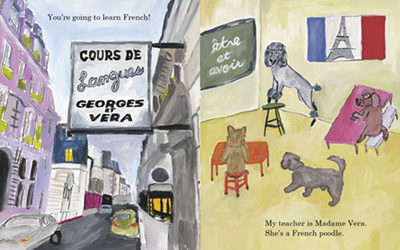
    In Paris-Chien (a pun on the French word parisien--OK, it took me a few minutes to get that one, and you have to pronounce Paris in French--par-ee--for it to work!), we meet Hudson, an adorable Norwich terrier who has recently moved to Paris with his American owner.  However, adjusting to a new culture is apparently as difficult for dogs as for people--Hudson didn't realize that French dogs spoke French rather than "dog"!  But no worries, his owner enrolls him in French language classes, taught by Madame Vera--a French poodle.  Soon Hudson is as happy as a clam--or maybe a baguette or croissant--in his new home, and even has a French girlfriend!


    This is a delightful book that is sure to please dog lovers and Francophiles alike.  The book is peppered with French phrases, which are translated in a "petit dictionnaire" in the back (although there is no phonetic translation, so the author seems to assume that the readers will already know a little French).  Children and adults alike will enjoy the "fish out of water" story of Hudson adjusting to Paris, told with a gentle sense of humor.  The gouache artwork is particularly charming, and the color palette and flat, stylized technique evoke 20th century French artists such as Matisse.

    Author Jackie Clark Mancuso was inspired to write this book by her own experiences as an ex-pat in Paris.  Hudson is a real dog, and you can learn more about him on his Facebook page.


    Monday, February 11, 2013

    Book Review: War Dogs: Churchill & Rufus, by Kathryn Selbert (Charlesbridge, 2013)

    Recommended for ages 7-12.  


    Winston Churchill was known during his lifetime as the British Bulldog, due to his famous tenacity.  In addition to being a great statesman, writer, and orator, Churchill was an animal lover, but it was not bulldogs who lived alongside the famous man, but miniature poodles.

    This new picture book by debut author/illustrator Kathryn Selbert tells the story of the British home front by highlighting Churchill's relationship with his poodle, Rufus.  The author opens with the following:

    "Rufus's best friend, Winston Churchill, is a busy man, but most days Rufus and Winston share a walk."

    It's 1940, and Winston is managing a nation at war.  Through the eyes of Rufus, Churchill's faithful brown miniature poodle, we see Churchill at work, visiting his secret underground bunker, the room from which he directs the war, going to the House of Commons, walking through streets filled with rubble from buildings destroyed by Nazi bombers.  Rufus is not always invited along however; when Winston meets with his allies, Franklin Roosevelt and Joseph Stalin, to plan D-Day, Rufus sits by the door, patiently guarding the bunker.  Rufus is once again by Churchill's side as the war ends, barking and howling with happiness.  In the end, Rufus and Winston retire to the country, resting..."two war dogs."  In the final lovely two-page spread dominated by the greens of the English countryside, Winston and Rufus gaze out to the horizon, with the country finally at peace.

    Back matter includes a timeline of World War II, a look at Churchill and his affection for poodles (he owned two during his lifetime, both named Rufus), and a brief biography of Winston Churchill himself.    The author also includes books for young Churchill fans, Churchill and World War II-related websites, a bibliography, and quotation sources.

    Acrylic and collage illustrations have an nostalgic yet realistic look, with plenty of sepia tones suggesting a time long ago.  Each two-page spread features a quotation by Churchill on a yellowed piece of paper, in an old-fashioned typewriter-style font, designed to look like it has been pinned to the rest of the picture. An interview on the Charlesbridge website indicates that this book grew out of an undergraduate school project, but that the book originally focused more on the relationship between dog and owner, and less on the historical details.  The book now provides more of an introduction to World War II, one that would be a good classroom read-aloud while studying that time period.  The book will, of course, capture the heart of dog lovers as well as history lover, with its illustrations that depict Rufus in all his poodle splendor.

    Disclaimer:  I am a poodle owner and a poodle lover.  Review copy provided by publisher.

    Churchill with the real Rufus 

    Monday, January 7, 2013

    Book Review: The Adventures of a South Pole Pig: A novel of snow and courage, by Chris Kurtz (Harcourt Children's Books, 2013)

    Recommended for ages 8-12.

    Children's books are filled with memorable pig characters.  Classics such as Freddie the Detective, Charlotte's friend Wilbur, and Babe the sheep-pig have been joined in more recent years by characters such as Poppleton, Mercy Watson, and Nanny Piggins.  To those wonderful porcines we must add a new member:  Flora the sled-pig.

    What animal lover, young or old, could resist a book with the unlikely title:  The Adventures of a South Pole Pig?  How on earth would a pig wind up in the Antarctic, we wonder?  Well, readers, never fear, author Chris Kurtz weaves indomitable piglet Flora into a charming South Pole adventure story filled with slops, friendship, danger, and humor.

    Flora, a piglet on a farm that raises sled dogs, wants nothing more than to explore beyond the limits of the pigpen she shares with her mother and siblings.  When she briefly escapes and has a chance to meet the dogs training at pulling sleds, she wants to join their pack, and soon is on the way to the South Pole with a bunch of dogs.  While she thinks she has a special mission to help the sled dogs, the reader quickly suspects that the cook has other plans for her (bacon, anyone?).  But when an iceberg hits their ship in the South Pole, it's the courageous Flora who saves the Captain's life.  Few of her shipmates survive, and soon it's Flora who has the chance of a lifetime to prove her mettle as a brave and irreplaceable member of the pack.  Will she succeed in helping to rescue her shipmates?

    This story would make a terrific read-aloud for a classroom or family, as well as a novel that children 8-12 could read easily on their own.  The novel has many appealing characters, among them a somewhat haughty cat, Sophia, who needs Flora's help to catch rats, a wise lead dog, Oscar, and a courageous young cabin boy, Aleric.  The novel is enhanced with adorable black and white illustrations by Jennifer Black Reinhardt.  Highly recommended!

    Tuesday, January 1, 2013

    Book Review: Finding Zasha, by Randi Barrow (Scholastic, 2013)


    Recommended for ages 9-14.

    Author Randi Barrow's debut novel, Saving Zasha, was one of my favorite historical fiction titles of 2011, and was recognized with many honors.  Not only was it terrific historical fiction, it was a great dog story, one that could appeal equally to both boys and girls.  I was therefore excited to read her newest novel, Finding Zasha, a prequel to Saving Zasha. 

    Set in the middle of World War II Russia, Finding Zasha is another page-turner, filled with adventure, danger, and yes, adorable German shepherd puppies being raised by the Nazis for nefarious purposes.  As the novel opens, we meet our hero, twelve-year old Ivan, who lives in Leningrad with his mother and loves to play his concertina.  When Leningrad is besieged by the Germans and its citizenry begin to starve, Ivan's mother sends him on a dangerous journey across a frozen lake to stay with an uncle in the countryside.  But as the Germans march across Russia, this seemingly safe town, too, is occupied by the Germans, and Ivan is determined to help the war effort by joining the Partisans, who work secretly to undermine the Nazis however possible.

    When a Nazi officer, the sadistic Major Recht, discovers Ivan's musical talents, he brings him to stay in the German camp, a valuable opportunity for Ivan to discover information which he can feed to the partisans.  At Nazi headquarters, Ivan also befriends two adorable German shepherd puppies, Thor and Zasha.  The Nazi commander plans to train the puppies to hunt Russians, and then breed them to create a corps of Russian-hating dogs.  Ivan can't imagine a worse fate for the innocent puppies, and dreams of somehow rescuing the prized dogs from their Nazi handlers.

    When a turn of events in the war provides an opportunity for Ivan and the puppies to escape the Nazi's clutches, he's separated from Zasha, and is torn between trying to rescue her and possibly put the partisans in danger or saving himself and the other puppy Thor.  And he lives with the knowledge that the vindictive Recht will stop at nothing to get his prized dogs back.  Will he ever find safety for himself and the dogs?

    Once again, Randi Barrow has penned an outstanding title with appeal for boys and girls alike, a "historical thriller"  (a phrase I borrow from author Laurie Halse Anderson) that will especially capture the imagination of animal lovers, students interested in history and World War II, and anyone who enjoys a good adventure novel.  I had a hard time putting the book down, as I followed Ivan's nail-biting story of the hardships of life in Leningrad during the Nazi siege, his harrowing journey out of Leningrad, his life with the partisans and under the nose of the Nazis, and his eventual escape.  This book can be read with or without having read its companion novel, Saving Zasha, although undoubtedly those who have read one of the books will be eager to read the other.

    The author includes a helpful afterword on Russia and World War II, which gives some historical context to the story, particularly to Hitler's campaign against Russia, the siege of Leningrad, during which one and a half million civilians starved, and the role of the partisans in Russia's war effort.


    Thursday, November 8, 2012

    Book Review: The Elephant from Baghdad, by Mary Tavener Holmes and John Harris, illustrated by Jon Cannell (Marshall Cavendish Children, 2012)

    Recommended for ages 5-10

    Here at the Fourth Musketeer, I am highlighting new historial picture books in honor of National Picture Book Month.  Authors Mary Tavener Holmes and John Harris seem to be expert in finding true but quirky animal stories from long ago to bring to new audiences via the picture book format.  Following their charming picture book A Giraffe Goes to Paris is this new account of an unlikely friendship between a very rare albino elephant and the Emperor Charlemagne in medieval Germany.

    This improbable but true story is told in the voice of a monk who chronicled Charlemagne's life in the 9th century.  The elephant, Abu, was a gift from Harun, the caliph of Baghdad, a great Muslim leader whom Charlemagne sent emissaries thousands of miles to meet.  Evocative two-page spreads show the magnificence of the city of Baghdad, with its beautiful buildings, libraries, scholars, and golden palaces with peacocks wandering in the gardens.  When the Europeans finally set off on the long journey home, they carry many fine gifts from the caliph to his fellow ruler, including a magnificent clock.   But the most magnificent gift of all was the elephant Abu, who led a caravan filled with treasures.  Upon arriving in Germany, Abu and his keeper were invited to live in Charlemagne's palace, and his image began to appear throughout Charlemagne's empire.  He even wore armor and was led into battle!

    Holmes and Harris write their story so that no prior knowledge of Charlemagne or this period of history is required to appreciate this fantastic tale.  As in their earlier book together, this book skillfully combines watercolor and ink illustrations with photographs of historical medieval art works.  It's an excellent friendship story for animal lovers or those interested in history.

    An authors' note gives further information on the monk Notker the Stammerer, who they imagine narrating the story, as well as background on the elaborate mechanical clock given as a gift by Harun to Charlemagne.  Unfortunately, the clock no longer exists.  The note also provides information on the sources used to research and write this story.