Showing posts with label 15th century. Show all posts

Tuesday, September 20, 2011

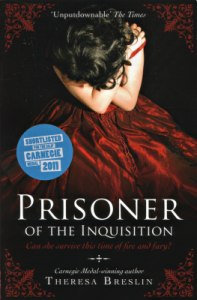
Book Review: Prisoner of the Inquisition, by Theresa Breslin (Corgi Books, 2011)

Recommended for ages 12 and up.

I don't usually order books from England before they are even available in the U.S., but when I read about Prisoner of the Inquisition in an article about England's prestigious Carnegie Award I couldn't help myself. Prisoner was short-listed for this year's Carnegie and won the Carnegie Shadowing Award (books chosen by young people who shadow the official judges and is written by a well-known author of historical fiction in her native Great Britain, Theresa Breslin.

One of my favorite historical fiction titles from back in my own teen days was Samuel Shellabarger's swashbuckling Captain from Castile, (adapted into a famous film with Tyrone Power), also set in the dark days of the Spanish Inquisition.  Scottish author Theresa Breslin's young adult novel focuses on some of the same themes of adventure, romance, revenge, and abuse of power by the church that I relished so many years ago in Shellabarger's novel.  In alternating chapters we meet two teenaged characters:  Zarita, the thoughtless, spoiled, only daughter of the wealthy town magistrate, and Saulo, son of a beggar.  Their lives intersect when Saulo's father, needing money to save his sick wife and hungry son, begs at the church where Zarita is praying, grasping her hand in desperation.  Saulo's father is soon cruelly executed for daring to assault Zarita, despite her pleas that the man does not deserve to die.  Saulo himself barely escapes the executioner's rope, and swears revenge on Zarita and her family.

Their stories are then told in parallel; Saulo is thrown into the harsh life of a galley slave, where through his wits, he is able to learn some navigation, is pursued by pirates, and eventually becomes acquainted with Christopher Colombus, a confident sailor from Genoa who hopes to gain patronage from the Spanish monarchs to explore an alternate route to the Indies.  Zarita, on the other hand, has troubles of her own.  The Inquisition has come to her town, and with it fear, suspicion, and cruelty.  No one is immune from the Inquisitor's tactics, even Zarita's aunt, a nun, a simple-minded relative, and Zarita herself.  Soon Zarita and Saulo's lives will intertwine again, in a way neither of them could ever have suspected.  Can they escape the dangers of the Inquisition?

I thoroughly enjoyed this historical novel about one of the darkest periods in Spanish history, although I found the transformation of Zarita's character from a self-absorbed young girl who thinks nothing of a poor beggar in the church to a kind, sensitive young woman a bit difficult to believe.  Some of the other characters in the book, including Zarita's young step-mother, are also somewhat one-dimensional, but the novel effectively captures the spirit of the period and is well worth reading.  I hope it will soon be released to an American audience.

Teens looking for other novels about this dark period in history may want to check out Alice Hoffman's Incantation (Harper Collins, 2004).

Friday, December 10, 2010

Book Review: City of Cannibals, by Ricki Thompson (Front Street, 2010)

Recommended for ages 12 and up.

This novel, by debut novelist Ricki Thompson, had been sitting on my nightstand for some time, patiently waiting its turn to be read, until one day when I was perusing the Cybils nominations and noticed that this novel had been nominated by none other than Karen Cushman, one of my favorite writers of historical fiction for young people.  That was enough of a recommendation to move City of Cannibals to the top of my pile.

I have to admit I was not particularly drawn to this book by the cover, and based on the blurb on the back and the title, I thought it was a fantasy story--which it is definitely not. So what is this book about? 

It's the engrossing story of a teenage girl, Dell, who lives with her drunk, abusive, and cruel father, her brother and auntie in Tudor England.  Her mother, a lady-in-waiting to Queen Catherine, wife of Henry VIII, is dead and buried on the hill near the cave where they live.  Finally Dell has had enough of the abuse and escapes with her only friend, Bartholomew, a puppet imbued by Dell with a lively and witty personality, to the city far below them.  Dell, and the reader, know the city as the City of Cannibals.  Her father has warned her ever since she can remember that people there eat each other's flesh, and drink human blood. We soon realize that the city is none other than London, a frightening place where Dell knows no one.  When she first enters the city gates, she decides her father was right..."this city was Hell, and now she was a part of it."  She knows only that she must seek out The Brown Boy, a mysterious young man clothed in brown garments who leaves packages for them in the hills every week.  In the city, she can invent a new identity for herself, as a puppet master, although she has only the one puppet to her name.

It's a time of turmoil in London; King Henry VIII has taken Anne Boleyn to be his wife, traitors who question the king are executed  in the public square, and the king's soldiers are plundering the churches.  But somehow in the London crowds, Dell spots the Brown Boy, who we learn is a novice monk named Ronaldo. When Dell falls ill in the city, she is taken in by the kindly John the Joiner, who through an unlikely coincidence turns out to know young Ronaldo as well.  They are involved in a dangerous game against the king, refusing to sign the Oath of Allegiance to him.  Dell becomes involved in their clandestine activities as well, delivering secret letters to monasteries. Thomas Cromwell, too, appears in the novel, with his book in which he writes the names of all those suspected of treason toward the king.

And Dell, for whom John the Joiner builds a puppet theatre, begins to perform at the London fairs, but her heart belongs to Ronaldo.  Can she save Ronaldo--and herself from Cromwell's powerful grip?

This is a rich and complex story that fans of books about Tudor England will really enjoy.  The book is set in 1536, a pivotal point in Henry's reign as he attempts to consolidate the power of the church in his own person.  An author's note provides some brief historical context, but some of the story might be confusing if the reader did not have a basic idea of the history at the time. Considering I recently read the massive adult novel Wolf Hall by Hilary Mantel (or more accurately, listened to the audiobook), the period was very fresh in my mind.  Teens will also enjoy the element of the forbidden romance between Dell and Ronaldo.  While some readers may be surprised at the sexuality between the characters, in fact priests breaking their chastity vows was a common enough ocurrance at the time, with plenty of priests and even popes having children of their own.  I particularly admired how the author does an outstanding job creating a sense of place in this novel; there is an earthy quality about the writing, with vivid descriptions of chamber pots, the river's fishiness, the clatter of the city.  Moreover, Dell was a character that the reader grows to care about, and I really loved her relationship with her sarcastic and witty puppet, Bartholomew (I have a feeling that Bartholomew was very unhappy not to be on the cover of this book, by the way!)

Check out the author's interview with Cynthia Leitich Smith on Cynsations, and other blog reviews in Bookish Blather, Whispers of Dawn, Parents Choice Awards,  and The 3 R's.

The author's website includes a discussion guide perfect for teen book groups or classroom use.

Disclosure:  Review copy provided by publisher.

Wednesday, June 9, 2010

Book Review: Nonna's Book of Mysteries by Mary Osborne (Lake Street Press, 2010)

Recommended for ages 12 and up.

Author Mary Osborne's trip to Florence inspired this engaging novel of Emilia, a young girl in 15th century Florence who dreams of becoming an artist. Very few women became artists at this time, and while her mother is supportive, her father is eager to have her understand "the way things are in the world." However, he indulges her and allows her to apprentice with a local artist, while disguised as a young boy. When her deception is revealed, she is dismissed, much to her dismay.

Emilia finds solace in a treasured book which has been in her family for generations, A Manual to the Science of Alchemy. This text, which Emilia considers to be little more than a family heirloom, contains passages from ancient texts that her mother assures her will help her get through difficult times. Throughout the novel, Emilia's story is interspersed with often mysterious quotations from this alchemy book.

When a grey-bearded man, a foreigner from Constantinople, finds her sketching in a Florence church, he offers her a position working with him at his workshop. While Makarios paints commissions for the Florentine gentry, he also creates ethereal icons from his own Orthodox tradition, and Emilia learns how to paint in this exotic tradition as well as in the Florentine style.

Emilia's head is soon turned by one of Makarios' patrons, a handsome and wealthy businessman from Genoa, Franco Villani. His flirtatious behavior makes Emilia believe that perhaps she could become his wife and the lady of his exquisite home. When they become engaged, it seems that all her dreams will come true. But when Emilia's friend Giacomo returns to Florence, she realizes she has romantic feelings for him as well when they exchange a passionate kiss. Giacomo warns her that we all have to make choices in life--will she choose Franco or Giacamo?

At the same time, Emilia's suspicions are aroused when her fiance Franco seems to take an inordinate interest in her ancient book of alchemy; when it disappears and other disasters begin to occur in her life, Emilia wonders if Franco could be to blame and how she can extricate herself from this marriage she once dreamed of. When she is asked to do a painting for the powerful Cosimo de' Medici, can he help her realize her dreams of being a successful artist and recover her family's treasured heritage as well?

This novel is the first of four in a series; the second, Alchemy's Daughter, is a prequel set about 100 years earlier.

As a former student of art history, I especially enjoyed the way Mary Osborne incorporated many well-researched details of painting and an artist's life during the Renaissance in her novel. She describes in detail everything from preparing walls for frescoes to grinding and mixing paints and preparing canvases. Teens who are used to picking up art supplies at the local Michaels or art store might be surprised at how time consuming painting was during this period.

While it may seem far-fetched to have a woman artist as the heroine in a novel set during the 15th century, there were a few women who succeeded in having artistic careers during the Renaissance (usually daughters of artists or members of the nobility), and certainly Osborne portrays how difficult it was for a young girl to pursue a path generally reserved for men.

Teen readers interested in more stories about girls craving to be artists during this period might also enjoy The Vanishing Point by Louise Hawes. This novel is based on the adolescence of Renaissance artist Lavinia Fontana, who lived in Bologna in the 16th century.