Showing posts with label African-American history. Show all posts

Monday, August 4, 2014

Book Review: Freedom Summer: the 1964 Struggle for Civil Rights in Mississippi, by Susan Goldman Rubin (Holiday House, 2014)


In this well researched book, author Susan Goldman Rubin takes us back to 1964 Mississippi, when the nation was shocked by the disappearance--and discovery of the murder--of three Freedom Summer workers.  The Freedom Summer workers were courageous young people, mostly college students from Northern schools, who travelled to Mississippi, living with black families, trying to register black voters and opening Freedom Schools to educate black children and their parents. 

Rubin follows the story chronologically, focusing on specific anecdotes which make the story more immediate for young people. The book is greatly enriched by personal interviews Rubin was able to do with participants, as well as extensive use of original source material. In addition, the book is handsomely illustrated with archival photographs and drawings. Extensive back matter includes information on the trial of the main organizer of the murders, who did not face justice until 2005. Information is provided on additional resources; there is also a timeline, source notes, reproduction of original documents, a detailed bibliography, and an index. This is an excellent nonfiction book for the new common core curriculum or for anyone interested in the history of the civil rights movement in the United States. Recommended for students in grades 5 and up.

Monday, March 10, 2014

Women's History Month Book Review: Mister and Lady Day: Billie Holliday and the Dog Who Loved Her, by Amy Novesky (Harcourt Children's Books, 2013)

Recommended for ages 5 and up.

Amy Novesky's most recent picture book, Mister and Lady Day, an ode to jazz great Billie Holiday and her pet dogs, just arrived at my library in time for Women's History Month.

This is Amy's fourth book on prominent female figures in cultural history; she has also penned Me, Frida (on artist Frida Khalo), Georgia in Hawaii (on artist Georgia O'Keefe), Imogen (on photographer Imogen Cunningham).  She is currently working on a picture book on sculptor Louise Bourgeois.

Billie Holiday's tragic life. which included working as a prostitute, living in a workhouse with her mother, drug addiction, a prison sentence, and more, might not seem like a natural fit for a picture book for young children, and indeed, this side of Holiday's life does not appear in Novesky's book.  Novesky focused instead on Holiday's love for her many dogs, and in particular for her boxer named Mister.  Love for a dog, of course, is a theme that children identify easily with, as do many adults (OK, I'm a sucker for a good dog story).

We first meet Billie Holiday as a young girl, dreaming of being a star, singing on a borrowed gramophone.  Illustrator Vanessa Brantley Newton, whose charming illustrations are done with gouache and charcoal with collage elements, depicts Billie in a beautiful setting on a fancy chair, dressed up with a bow in her hair (perhaps a bit fanciful given the realities of her childhood!).  The next spread shows her already a star, the great Lady Day. (Illustrated 2-page spreads from the book can be seen on Novesky's website).   Novesky introduces a note of melancholy in the text from the beginning, by explaining that even stars need someone to listen to them, and that's the role Lady Day's dogs played.  We meet her small dogs, chihuahuas Pepe and Chiquita, her big dogs (a Great Dane named Gypsy, and finally her favorite dog of all, Mister, who we see in a fabulous illustration, walking with Billie on a leash wearing matching mink coats.  Instead of a sidewalk, they are walking on a piano keyboard, with the buildings of New York in the background.  Mister had the life of a star himself; he was so pampered he got to eat steak while she was performing in glamorous clubs, and he waited for her while she performed, even serving to keep eager fans at bay.

Novesky tells young readers that "Lady got into trouble. She had to leave home for a year and a day. And Mister couldn't come."  In an afterword, she explains that Billie Holiday was in fact in jail during that time for drug possession.  When she returned, Mister was there to welcome her, and even accompanied her to a grand concert at New York's Carnegie Hall.  The story ends on a hopeful note, with Billie singing her heart out, and Mister listening in the wings.

An author's note gives some more background on Holiday's life, appropriately omitting some of the uglier facts, and provides additional sources and a web resource.

There's no CD with the book, but readers could easily find CD's of Holiday's unique singing style at the library or on YouTube, which would enrich the story.

This is a moving yet charming book about a difficult subject, and could be integrated into units on Black History Month, Women's History Month, or jazz.

Monday, February 24, 2014

Book Review: The Invention of Wings, by Sue Monk Kidd (Viking, 2014)

Recommended for ages 14 and up.

I first learned about the Grimke sisters of South Carolina through the Kidlit Celebrates Women's History Month blog, as they were one of the Civil War era women profiled on storyteller Jim Weiss' CD Women in Blue or Gray:  True Stories from Both Sides of the Civil War.   I again heard their story in a PBS American Experience documentary aired in 2013, The Abolitionists.  But neither captured my imagination as completely as Sue Monk Kidd's fascinating new novel, The Invention of Wings, which focuses on the elder of the Grimke sisters, Sarah, and her slave, Handful.

The Grimke sisters, separated in age by 12 years, were born into a wealthy Charleston slave-owning family, and, like other young Southern women of their class, were expected to study French, drawing and other lady-like pursuits, then make a good match and raise a family.  As Kidd tells Sarah's story in the first person, beginning with her girlhood, she never fit into the hole society carved for her.

With her keen intellect, she yearned to become a lawyer like her brother, but her dreams of pursuing a career were ridiculed and then squashed by her family.  When presented with a slave on her 11th birthday, she tried to free the young girl, called Handful, but when her father ripped up the manumission papers she soon decided to teach the girl to read--the only sort of freedom she could offer her.  When her family found out, she was severely punished--all books were denied her--and so was the slave girl.  She takes comfort in the birth of her youngest sister, Angelina, and persuades her mother to make her the child's godmother, and thus begins a close relationship that went considerably beyond sisterly bonds.  Angelina, too, develops a horror of slavery, and we discover through the diary-like narrative that the Grimke sisters' destiny does not lay in Charleston, but rather in the North, where they become Quakers and become the first female soldiers for the abolitionist cause.  This, we must remember, at a time when the idea of women speaking in public places was unheard of.  At the same time, they were among the first to champion women's rights, even more shocking than taking up the cause of slaves.  Their scandalous behavior for the time made them famous around the United States.  Indeed, their anti-slavery pamphlets, addressed to Southern women, were best-sellers in their time, and were inspirational to Harriet Beecher Stowe in her writing of Uncle Tom's Cabin.

Sarah Grimke


In alternating sections, we follow the life of Handful, the slave given to Sarah on her birthday.  Handful is a house slave, schooled in sewing like her mother, and becomes indispensable to the household.  While her life may have been better than a field slave, she craves for freedom, and pays a cruel price for her longing.  Her story is given equal weight to that of the Grimkes, and in an afterword the author describes how while Handful is fictional, she is based loosely on the actual slave that was given to Sarah Grimke on her birthday (although that individual died a few years later).  While the Grimkes' house slaves may be fictional, they are well developed characters, and their story is interwoven with a planned slave revolt orchestrated by Denmark Vesey, a free black historical figure who plays a substantial role in the novel.

While this is an adult novel, I would recommend it highly for high school and even middle school students who are interested in US history and women's history.  It is extremely well written and provides great insight into life at that time, as well as portraying two amazing sisters who were infamous in their time (described in the novel as the most famous women in the country) but who are sadly practically unknown today.  Their inspiring story would also be an excellent choice for a book club.

There are several books for children on the Grimkes, including Sisters Against Slavery:  A Story about Sarah and Angelina Grimke (Stephanie McPherson, 1999)  but no picture books.  Authors:  we need an outstanding new resource on these amazing women!

Monday, January 20, 2014

Family Storytime honoring Dr.Martin Luther King, Jr.

Every Tuesday evening I am responsible for a family storytime for about 50-60 people, ranging from babies and toddlers to school-age children to parents.  It's a valuable opportunity not only to entertain and encourage a love of reading, but also to (hopefully) teach something to the audience.

This year I had my second annual Martin Luther King storytime.  Dr. King's life and legacy do not lend themselves easily to a crowd of this diversity of ages, but fortunately there are many wonderful books on Dr. King out there to choose from, and more are published each year.

These are the books I shared at this year's storytime:

My Daddy, Dr. Martin Luther King, Jr. by Martin Luther King III is a recent (2013) release from Harper Collins and a welcome addition to the King bibliography.  Only 10 when his father was killed, "Marty" tells about what it was like to grow up with the famous Dr. Martin Luther King Jr. as your father, in a way that's immediately relatable to children. For example, he and his siblings were begging to go to Funtown, a local amusement park, but Dad never would take them.  We then learn that Funtown was open only to whites. His dad was often away, but when he was home he liked to play airplane with Marty, even lifting him on top of the refrigerator (parents, don't try this at home).  We see King as a warm, caring man who loved his family.  But it wasn't easy to be the son of this great man, and sometimes Marty was afraid to tell kids at school his name, because he knew that his father was hated by many people, even though he never hurt anyone or committed violent acts.  At Christmas he and his brother were given toy guns as a gift (we aren't told by whom) but they are made to burn them in a bonfire since guns, even toys, were not permitted in their house.  The book ends on a hopeful note with Marty and his sister helping to integrate a local school.  An afterword tells of Dr. King's death and speaks briefly of his legacy.

We Shall Overcome:  the Story of a Song, by Debbie Levy (Jump at the Sun, 2013) is another new release which fits perfectly with Dr. King's birthday.  This is not the first children's book devoted to this song, but is the one best suited to be read aloud to young audiences.  Unfortunately the book doesn't come with a CD, so I used one of Pete Seeger's versions to play for the audience.  The version I used is from Pete Seeger's Greatest Hits, and was recorded live in concert with a huge crowd singing with him in the background.  The book traces the history of the song from slavery days to the present, including how the song was instrumental in the civil rights movement.  We see Pete Seeger singing the song for Dr. King, we see President Johnson quoting the words from the song in a television address, how the song spread to different countries fighting for freedom such as South Africa and China, and how the song was sung at the inauguration of our first black president.  The book presents a message of hope combined with colorful illustrations which enhance the message of the book.
Dr. Martin Luther King is well known for preaching a message of nonviolence and peace, but peace is not an easy concept to explain to young children.  I chose to also share beloved children's author and illustrator Todd Parr's book on the subject:  The Peace Book (Little Brown, 2009).  Each spread offers a different definition of peace, from hugging a friend to keeping the streets clean.  The book ends with a celebration of diversity:  Peace is being who you are, with Todd Parr's signature children depicted in various primary colors.  

Did you know that Dr. King's favorite dessert was pecan pie?  And I bet you didn't know that two 11" pies can serve 50+ people--just dish spoonfuls of the delicious mixture into cupcake holders, top with a dollop of whipped cream (or Cool Whip), and voila, you can stretch two pies an amazing distance!  Everyone (except a few with nut allergies) relished the delicious treat.  After explaining that the dove was a symbol of peace, we concluded with an art activity in which we had prepared a white template of a dove, pre-glued it on blue paper, and provided do-a-dot paints for the children to use to decorate the bird.

Have you done storytimes on Dr. King?  Please share your favorites in comments below!

Monday, May 6, 2013

Kareem Abdul Jabbar and What Color is My World: The Lost History of African American Inventors (Candlewick, 2012)

Kareem Abdul Jabbar, April 2013
I was thrilled to have the opportunity several weeks ago to hear basketball great Kareem Abdul Jabbar speak at a library event about his books, in particular about his children's book, What Color is My World:  The Lost History of African American Inventors (co-written with Raymond Obstfeld).  I grew up with a father who was a sports fanatic; in the absence of sons, he took his two daughters regularly to see the Lakers play at the Forum in Inglewood.  I saw Kareem Abdul Jabbar play countless times (and his predecessor, Wilt Chamberlain) and have many fond memories of cheering for him and his teammates.

Walking into a room filled with library staff, he literally seemed to be double the size of most of the people in the room, and despite his reputation as being introverted, he seemed at ease speaking with his audience of librarians and library support staff.  Wearing a UCLA Bruins cap (no Lakers garb in sight), he gave an inspirational talk about what inspired him to write two of his books:  What Color is My World, and On the Shoulders of Giants, a book about the Harlem "Rens," an all-black basketball team from the segregated days of professional basketball.  He bemoaned the fact that so many African American young people seem to think that the only avenue to success is to be Jay-Z or Kobe Bryant, and said he wrote What Color is My World to help inspire young people to consider other careers.  During a lively Q&A, he answered a variety of questions on his own role models in basketball (Bill Russell and Wilt Chamberlain), his fond memories of Coach John Wooden, his inspiration for writing, and more.

What Color is My World is an assortment of biographical sketches of famous and little-known black inventors, ranging from George Crum, inventor of the potato chip, to Dr. Charles Drew, who developed the concept of large scale blood banks.  The biographical sketches are enveloped in a fictional story about twins who have moved into a new house and meet an old handyman who's coincidentally just full of knowledge about African-American history, particularly scientists and inventors.  This scheme provides an engaging setting for telling the stories of these remarkable men (unfortunately, only one woman is included among those discussed).  The design of the book is also noteworthy--it's abundantly illustrated with full-color illustrations and there are flaps which kids can open which discuss each of the scientists, giving a portrait and brief "fast facts".  When the reader opens the flap, he or she will find more information about that particular inventor and his invention.  Below are examples of several spreads from the book.


I would highly recommend this book to any young person interested in science and technology, regardless of his or her race.  It's also a fun and entertaining book for parents to share with their kids.

Monday, February 25, 2013

Black History Month Book Review: A Voice of Her Own: The Story of Phillis Wheatley, Slave Poet, by Kathryn Lasky (Candlewick, 2012)

Recommended for ages 7-12.

Candlewick has recently reissued in beautiful full-color paperback editions several biographies of famous African-American women by Kathryn Lasky.  Earlier this month I reviewed Vision of Beauty:  The Story of Sarah Breedlove Walker.  In A Voice of Her Own, Lasky shares the story of an equally extraordinary woman, Phillis Wheatley, known as the first black woman poet in America.

Lasky begins her book as a young girl is kidnapped from Africa and sold into slavery in America in 1761.  Through the girl's eyes, Lasky describes the harrowing journey from the west coast of Africa.  A powerful illustration, painted in acrylics, shows a terrified young girl huddled in the hold of the ship.  Upon arrival, she is purchased at a Boston slave market by the Wheatley family and given the name Phillis.  When we next meet Phillis, we learn that she has become no ordinary slave.  Mrs. Wheatley, realizing quickly how bright her new young slave was, decided to teach her to read and write, a sort of social experiment to see if an African could learn and understand the Bible.  While this sort of instruction was not illegal as it was in the South, it was nevertheless never done.

Phillis proved to be such an able student that she progressed beyond English to Latin and Greek, geography and mathematics--this at a time when few white women were offered this sort of education, and only the elite among white men.  Phillis was especially attracted to poetry, and had her first poem published when she was only fourteen years old.  Phillis became a celebrity in Boston, and was trotted out by her mistress to all the finest houses in town as a sort of curiosity.

Phillis Wheatley. Poems on Various Subjects. London, 1783

Ironically, Boston printers refused to publish a compilation of Wheatley's poems, refusing to believe that a Negro slave could have written them, even after a panel of distinguished Bostonians, including John Hancock, interviewed her and vouched for her.  Instead, the Wheatleys sent Phillis on a trip over the ocean to London, where she met a British publisher willing to publish her volume, and was received in the finest homes.  Returning to America when she learned her mistress was ill, she continued to write, even as Boston rebelled against the British.  After being published in London, her book sold well in Boston, and Phillis' fame grew.  She was even invited to meet General Washington after writing a poem in his honor.

In an epilogue, Lasky relates briefly the last years of Wheatley's life; after receiving papers freeing her from slavery from the Wheatleys, she married and had three children, all of whom died in infancy.  Her final poem, "Liberty and Peace," celebrated the end of the war, and she died in poverty at the age of thirty-one.

Back matter includes an index and a list of selected sources, as well as notes from the author and illustrator.  The text includes a few brief quotations from Wheatley's poems.

At a brief 38 pages, with beautiful and abundant color illustrations, this very accessible biography is one step up from a picture book, and could be read aloud in class or by parents as well as read independently by students in about third grade and up.  While the author provides plenty of information for a biographical report, the subject matter is fascinating and suitable for general reading as well as school assignments.  Phillis Wheatley's remarkable rise from an illiterate slave to a literary figure celebrated on both sides of the Atlantic is an inspiration to share with children, particularly during Black History Month or Women's History Month.

Monday, February 4, 2013

Book Review: Vision of Beauty: The Story of Sarah Breedlove Walker, by Kathryn Lasky (Candlewick, 2012)

Recommended for ages 7-12.

Candlewick Press has recently reissued in paperback Kathryn Lasky's biography of Sarah Breedlove Walker, originally published in 2000.  In a brief 48 pages, Lasky chronicles the life of this remarkable woman, born into poverty to former slaves, who became a highly successful entrepreneur and philanthropist.  Orphaned at the age of seven, Sarah had a difficult childhood, and married at the age of 14 to escape living with her sister and her cruel husband.  She eventually moved to St. Louis where she worked as a laundress and diligently saved to be able to give her daughter the education she never had.

Because of poor nutrition, Sarah's hair began to fall out, and she began to work on a formula that would produce healthy hair for African-American women.  After testing her products on herself, she began selling door-to-door, and eventually expanded her products into the Madam C. J. Walker Manufacturing Company, a business empire which made her the wealthiest black woman in America.

In a brief, easy to read narrative, Lasky hits on the highlights of Walker's life, emphasizing how remarkable her success was in an era when she had two strikes against her--being female and being black.  My favorite scene in the book involves Waker attending a conference of African-American business leaders, all of whom (of course!) were men.  Lasky describes how Walker tried unsuccessfully to get the attention of Booker T. Washington, so that she could speak.  She finally sprang to her feet, relating how she came from the cotton fields of the South, promoting herself into the business of manufacturing hair goods.  "'My object in life is not simply to make money for myself, but to use part of what I make in trying to help others,' continued Madam Walker...With these words, Madam Walker proved herself more than equal to any man in that room."

Sarah Breedlove Walker
An epilogue describes Walker's commitment to philanthropy and to civil rights; her dying words were "I want to live to help my race."  Back matter also includes an illustrator's note an index, and selected sources.

Abundantly illustrated with beautiful full color watercolor paintings by Nneka Bennett, Lasky's book is an inspirational tale that could be read aloud or read independently by children in elementary school.

Monday, January 21, 2013

Best Picture Books about Martin Luther King, Jr.

Dr. King has been on my mind of late.  Now that I am working as a full-time children's librarian, I was excited to organize a program for our family storytime in his honor.  Since it happened that the program fell on his actual birthday, February 15, rather than the federal holiday, we read--and acted out--picture books about him, and sang Happy Birthday and instead of having cake, tasted his favorite dessert, pecan pie (served up in very small servings in cupcake liners!).  The program turned into a family occasion, as my banjo-playing mother-in-law and my teenaged son came to teach the children and adults some of the iconic civil rights protest songs:  We Shall Overcome, We Shall Not be Moved, and This Little Light of Mine.

There's a rich variety of books available on Dr. King, aimed at all ages, yet it was not difficult to choose which books I wanted to highlight.  Here are some of my favorites, although I was not able to read them all at the storytime.

I Have a Dream, by Dr. Martin Luther King, Jr., illustrated by Kadir Nelson (Schwartz & Wade, 2012).  Kadir Nelson has outdone himself with the magnificent oil paintings he produced to illustrate some of the most iconic excerpts from Dr. King's most famous speech (the complete text is included in the back of the book, as is a CD with Dr. King delivering the address).  This is a book that should be in every American classroom and library.  The dignified and statuesque artwork, combined with Dr. King's inspirational language, cannot fail to move anyone who sees and reads this book.

Martin's Big Words:  The Life of Dr. Martin Luther King, Jr., by Doreen Rappaport, illustrated by Bryan Collier (Hyperion, 2001).  In a book suitable for kindergartners on up, Rappaport brings Dr. King's career to life using simple but eloquent language and Dr. King's own powerful words, taken from various speeches and letters from throughout his lifetime.  Combined with outstanding artwork by Bryan Collier, her text is perfect for reader's theatre; at my own program, three children read the words of Dr. King and I read the narrator part, making a very moving small piece of drama perfect for the classroom or library storytime.

My Uncle Martin's Big Heart, by Angela Farris, illustrated by Eric Velasquez (Abrams, 2010).  This warm-hearted picture book tells Dr. King's life told from the perspective of his young niece.  Dr. King comes through as a family man, Uncle M.L. who loved to laugh, not just an icon of the Civil Rights movement.

My Brother Martin:  A Sister Remembers Growing Up with the Rev. Dr. Martin Luther King, Jr., by Christine King Farris (Simon & Schuster, 2003).  In this outstanding book written by King's older sister, we see Martin Luther King as a mischievous young boy, not wanting to practice the piano, surrounded by a warm and loving well-educated family who tried to shield their children from the worst of segregation.  Dr. King's father, stood up to the worst of the bigotry of that time, and the young King learns the importance of standing up for justice and equality.  A powerful book that can be easily understood by elementary school-aged children.


Monday, January 14, 2013

Book Review: A Spash of Red: The Life and Art of Horace Pippin, by Jen Bryant (Alfred A. Knopf, 2013

Recommended for ages 7 and up.

This new picture book biography by Jen Bryant chronicles the unusual story of Horace Pippin, a self-taught African American folk artist who didn't complete his first painting until he was over forty years old.  Born in 1888, Horace quickly demonstrated a love of drawing, and everyone loved his pictures.  One day, Horace entered a magazine contest, and won his first art supplies--paints, colored pencils, and brushes.  In 8th grade, he had to quit school to go to work to help out his family, but he continued making pictures using whatever materials he could find.

Horace joined the army and went to France to fight in World War I, and even in the horrible trenches, where conditions were miserable, Horace filled his notebooks with drawings for his friends.  But a serious injury to his arm by a bullet left Horace unable to lift or move his arm the way he used to.  Would he ever be able to draw again?

But Horace's desire to create was not easily stopped, and he managed to teach himself to paint by using his left hand to hold up his right.  Through his art he expressed the pain of his war experiences, as well as chronicling a variety of other subjects from domestic scenes of women working in the kitchen to Bible stories and scenes of cotton fields.  It took him three years to finish his first painting, and soon he was able to hang his paintings around town.  But no one bought them, at least not until the head of a local artists' club saw Horace's pictures, and brought his friend, the famous painter N.C. Wyeth to see them.  Soon Horace achieved great fame, and his paintings were collected by people from all over the world.

Back matter includes a historical note with further biographical background on Pippin, notes from the author and illustrator, and suggestions for further reading, as well as recommended websites on Pippin and quotation sources.  The end papers show a map of the United States indicating places where we can see Pippin's paintings, along with reproductions of some of his original works.

I was not familiar with the work of Horace Pippin before reading this work.  Jen Bryant's text, while accessible for young children, will spark the imagination of older children and even adults to explore further the work and life of this African-American artist.  Bryant and illustrator Melissa Sweet do a wonderful job of capturing not only the spirit of Pippin's artwork, but his determination and resolve to rise above the many difficulties he experienced in his life.  Sweet, the author-illustrator of Balloons over Broadway and the illustrator of more than eighty other picture books, manages to evoke Pippin's use of color and composition in her own illustrations.  The illustrations are created using watercolor, gouache, and collage, and incorporate quotations from Pippin as well as images.  Sweet writes in her illustrator's note that "Lettering Pippin's quotes within the illustrations gave me a way to illuminate his simple and heartfelt approach to making art."

This is a terrific book to share for Black History Month or any time you would like an inspirational picture book biography to share with children or a class.

Amazon has selected A Splash of Red as one of its Picture Books of the Month for January.


Monday, November 5, 2012

Nonfiction Monday Book Review: Spirit Seeker: John Coltrane's Musical Journey, by Gary Golio (Clarion, 2012)

Recommended for ages 9 and up.

National Picture Book Month is the perfect time to highlight this new book by author Gary Golio, who adds John Coltrane to his growing collection of picture book biographies of musical greats.  Earlier books, reviewed here on the Fourth Musketeer, profiled Jimi Hendrix and Bob Dylan.  While these musicians might not seem like typical fodder for children's picture books, this format, with its striking and inspirational illustrations, is in fact ideal for stimulating young people's interests in these iconic musicians.

The book's title page features the following quote from Coltrane:  "My music is the spiritual expression of what I am...I want to speak to their souls."  We first meet John Coltrane as a young boy, in North Carolina in 1938, listening to his grandfather preaching on a Sunday morning about the power of the Spirit.  John's life was "like a little slice of heaven," with plenty of food, games, and a loving family surrounding him.  His father, an amateur musician, filled the house with his singing and tunes from his ukulele and violin.

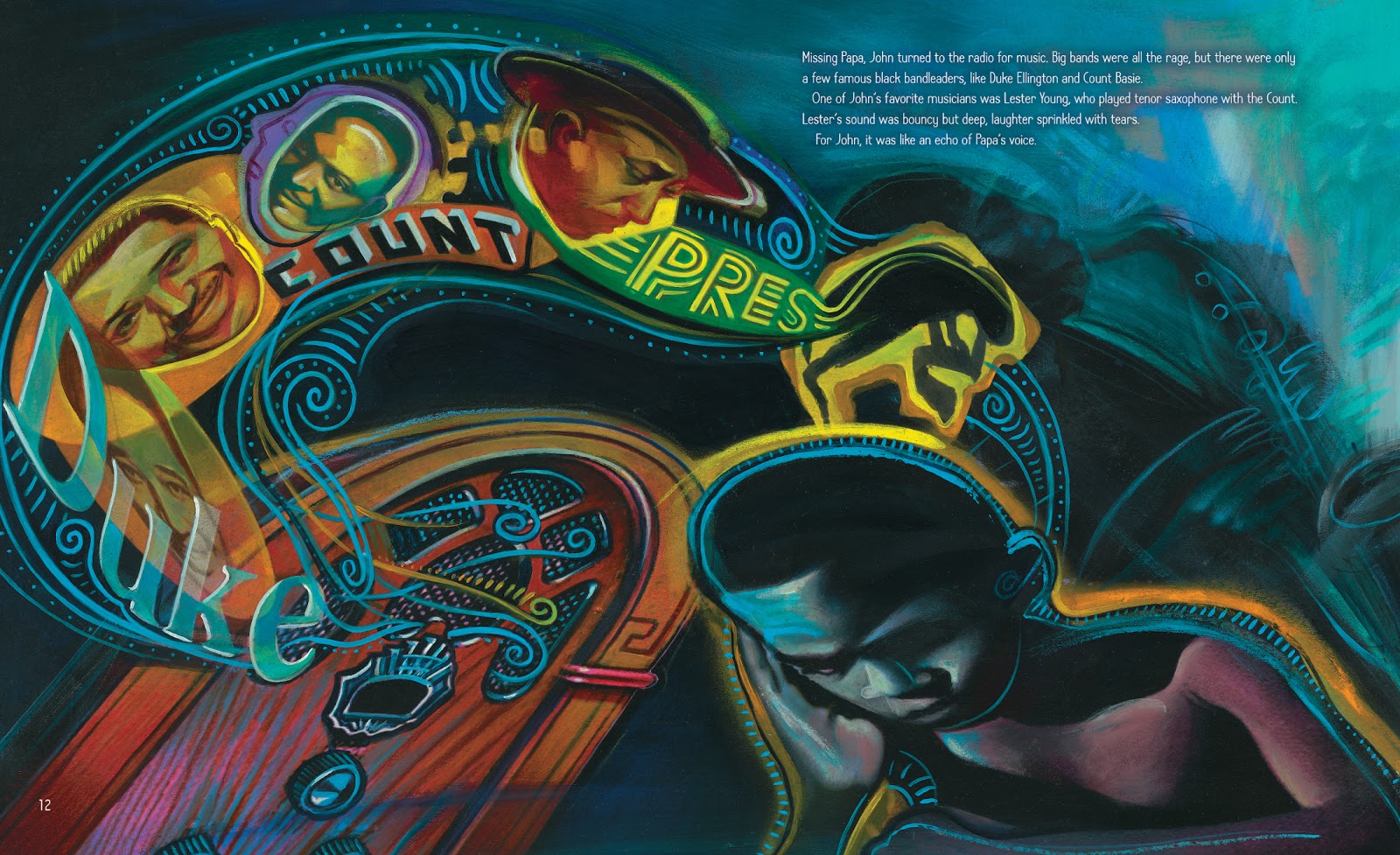
But at the age of 12, John lost his two grandfathers, his grandmother, and his father in rapid succession.  Turning to music for consolation, he was fortunate to receive a used alto sax, which he soon took everywhere, practicing for hours and hours.  Moving to Philadelphia, he began playing with big bands and blues groups, and absorbing the music of jazz greats like Charlie "Bird" Parker.  Although he was achieving success, life on the road was lonely, and John turned to alcohol and drugs for company, turning away from his spiritual underpinnings.  Soon "he had to choose, between the dead end of drugs or a life rich with music." Will he find the strength to get clean and regain his inspiration?

Golio's narrative features Coltrane's spiritual journey front and center, in which he used music in his attempt to "unlock the mysteries of life."  Coltrane's spiritual explorations culminated with his masterpiece, A Love Supreme, which Golio poetically describes as the "song of the human heart reaching up to heaven."

In addition to being an accomplished author, Golio is a licensed therapist who specializes in treating addiction problems, which may be part of the reason he feels comfortable interpreting the stories of musicians such as Coltrane and Hendrix for young people.  The book's afterword includes a note on musicians and drug use, in which Golio explains that while musicians are no different from other people who use alcohol and drugs to deal with their emotions, they may be even more vulnerable to addiction due to the demands of touring and performing and the belief many artists have that drugs can make a person more "free" or "creative."


one of the stunning illustrations from Spirit Seeker

Golio has a gift for expressing music with words, just as Coltrane turned feelings into sounds. But it is impossible to discuss this work without highlighting the outstanding illustration by Rudy Gutierrez, a Pura Belpre Honor-winning artist who has also designed album covers and clearly has an affinity for music.  In an artist's note, he explains that he fasted for two weeks and meditated, much as Coltrane did when he composed A Love Supreme, to seek inspiration for illustrating Golio's tribute to Coltrane.  The illustrations include acrylic paintings and mixed media pieces done with colored pencils, crayons, and acrylics.  The dream-like compositions, dramatic movements and use of contrasting and complementary colors evoke the energy of Coltrane's music.  Many of the spreads from the book can be seen on Gutierrez' website.

For more on this book, check out Gary Golio's interview in School Library Journal at this link.

Thursday, September 13, 2012

Book Review: Jump into the Sky, by Shelley Pearsall (Alfred A. Knopf, 2012)

Recommended for ages 10-14.

In her new historical novel Jump into the Sky, award-winning historical fiction author Shelley Pearsall explores a little known footnote in World War II history--the 555th Parachute Infantry Battalion, the first black paratrooper unit in the U.S. Army.

The story of the 555th unfolds through the eyes of thirteen-year old Levi, who's been living with his aunt in Chicago while his father serves in a secret Army mission.  It's May, 1945, and the war is drawing to close.  Levi's aunt decides to send him off by train to stay with his father at his dad's last known address, an army post in North Carolina.  Not only does his father not know he's coming, Levi arrives in the Jim Crow South without a clue as to the behavior expected of a "colored boy" and almost gets himself killed for trying to buy a Coke at the wrong store.  And to make things more difficult, his father's unit has been sent all the way to Oregon.  Will Levi have to go back to his aunt, who doesn't want him any more, or will he be able to find his father in Oregon?  And will his father survive the dangerous mission assigned to the 555?

This novel is a powerful story of racism and courage in the not-too-distant days of the Jim Crow South and a segregated American military.  Although the main characters of Levi and his father are fictitious, the novel is carefully researched and many of the incidents described really happened, including the scene at the country store with the Coca Cola.  Moreover, the novel is peppered with colorful real soldiers from the 555th, including "Tiger Ted" Lowry, who once fought Joe Louis in an exhibition match.  An author's note describes how she first learned of this battalion, which was part of a secret operation to protect the U.S. from Japanese balloon bombs.  This balloon bombing strategy of the Japanese is certainly a "truth is stranger than fiction" story.  Pearsall was fortunate to interview a veteran of the unit, Walter Morris.  Further details on the 555th can be found at the unit's website, triplenickle.com.

I would highly recommend this book to middle schoolers looking for a good adventure story that brings a little known part of World War II history to life.


Tuesday, March 27, 2012

Women's History Month Book Review: Touch the Sky: Alice Coachman, Olympic High Jumper, by Ann Malaspina (Albert Whitman, 2012)


Recommended for ages 5-10.

Young Alice Coachman, growing up in segregated Albany, Georgia, in the 1930's, just couldn't help herself.  She wanted to soar and touch the sky.

"Bare feet shouldn't fly./Long legs shouldn't spin./Braids shouldn't flap in the wind./'Sit on the porch and be a lady,' Papa scolded Alice," this book about the future Olympic athlete begins.  When she watched boys doing the high jump at a track meet, "Alice's feet tingled, wanting to try."  

We see Alice's dreams growing bigger as she gets older, until finally the high school coach needed a jumper for a track and field tournament in Alabama.  Her family was too poor to afford proper clothes for the competition, so her teachers pitched in and bought her shoes, shorts, and bright white socks.  For the first time, she competed with the best black athletes in the South.  In 1939, she won her first national medal, and soon she was asked to enroll at Tuskegee, where she'd be able to train with the best.  Alice worked hard to pay her school fees.  

Alice dreamed of the Olympics, but with the world consumed by war there were no games to enter.  Could she still compete in 1948?  Would she achieve her dream of a gold medal in the high jump--and  finally touch the sky?  

Written in a simple yet poetic style, this book captures the spirit of a true American heroine and a pioneer in sports, one who is not widely known today.  It's a real "girl power" story, as well as a tale about overcoming prejudice.  The stunning large format oil paintings, by illustrator Eric Velasquez, with their vibrant colors and sweeping compositions, capture the intensity of Alice's story, and especially of her jumping.  

An author's note shows photographs of the real Alice and her teammates and tells about what happened to Alice after her triumph at the Olympics.  A bibliography is also included.  

Alice Coachman

When it rains, it pours, and another picture book about this outstanding athlete will be released later this month.  Queen of the Track:  Olympic Champion Alice Coachman, is published by Boyds Mills press.  It's written by Heather Lang and illustrated by Floyd Cooper.  


GIVEAWAY:   Would you like to know more about Touch the Sky and win a copy of this book and other women's history picture books?  Check out Ann Malaspina's post at Kidlit Celebrates Women's History Month and leave a comment to enter.  


Monday, March 12, 2012

Nonfiction Monday/Women's History Month Book Review: Zora! The Life of Zora Neale Hurston, by Dennis Brindell Fradin and Judith Bloom Fradin (Houghton Mifflin Harcourt, 2012)

Release date:  August 28, 2012


Recommended for ages 10-14.  


Although I haven't read any of Zora Neale Hurston's original work, I was fascinated by this upcoming biography for young people of the celebrated African-American novelist of the Harlem Renaissance.  Written by veteran nonfiction writer Dennis Fradin (he's published over 200 nonfiction books!) and his wife Judith, this book tells the story of an extraordinary woman who knew she was special from an early age.  She grew up in the unique all-black town of Eatonville, Florida, where she was unaware of racism and grew up so self-confident that she believed the moon followed her wherever she went.  From her childhood on, she loved to tell stories, and had a wonderful imagination.

While a student at Howard University, Zora was accepted into their literary group and had her first work published.  From the beginning, her work featured realistic dialogue, with the characters speaking in a dialect modelled on the real people she had grown up with.  When she was in her thirties, she moved to New York City to try to make it as an author, with $1.50 in her pocket, "no job, no friends, and a lot of hope."  There she befriended important writers such as Langston Hughes and became recognized for her work as an anthropologist as well as a writer.

The book points out that despite the recognition she received during her lifetime for her books and folklore work, Zora remained poor, and even had to take a variety of "day jobs," including work as a librarian, maid, personal assistant, waitress, college drama teacher and even as a Hollywood script consultant.  By the end of her life in 1960, all her works were out of print; in the 1970's, they were rediscovered by a new generation of African-American writers, including Alice Walker, and her books have now been republished.  In fact her most popular work, Their Eyes Were Watching God, has sold more than 5 million copies, and is used in many high schools as part of the curriculum, as well as being made into a movie produced by Oprah Winfrey and starring Halle Berry.

This is a great biography to recommend for kids from 9-14 years old, and provides plenty of information for those school biography reports.  Her incredibly varied life, in which she achieved some fame, but little financial success, is a remarkable testament to her persistance and her spirit, and the book does an excellent job of portraying the different sides of her life, both the complicated personal (she was married and divorced three times) and professional aspects aspects of her story.

Zora Neale Hurston

The book is abundantly illustrated and also includes many quotes from Zora Neale Hurston's own writings, which give the text a real flavor of the author particularly for young people who may not read her books until high school.  Back matter includes an excerpt from one of her folktale collections, a timeline, source notes, and a bibliography.

For more on Nora Zeale Hurston's childhood in Eatonville, I recommend Zora and Me, a middle-grade mystery novel by Victoria Bond and T. R. Simon (Candlewick, 2010), which imagines Zora's childhood in Eatonville from the point of view of her best friend, Carrie.

Monday, February 27, 2012

Book Review: Crow, by Barbara Wright (Random House, 2012)

Recommended for ages 8-12.

Another excellent choice for Black History Month, this historical fiction novel for middle-grade readers, takes a little known race riot and coup d'etat that occurred in Wilmington, North Carolina, in 1898 as the inspiration for creating a compelling story of eleven-year old Moses and the destruction of the middle-class African-American community in which he lived.

It's just one generation after the end of slavery--Moses' own grandmother, Boo Nanny, was born a slave, but in the years since Emancipation, Moses' family has risen into the middle class.  His father is college-educated, works for the local black newspaper, and is also a town alderman.  When the editor of the black newspaper writes an editorial in which he suggests that it's no worse for a black man to be intimate with a white woman than for a white man to be intimate with a black woman, "big trouble's a-brewing" in Wilmington.  Will Moses and his family escape the ensuing violence that erupts?


Creating a compelling voice for young Moses, author Barbara Wright has created a moving and shocking story about the Jim Crow South that received well deserved star reviews from Kirkus, Publisher's Weekly, School Library Journal, and Horn Book.  You can read an excerpt at her website.  Her website also offers resources for teachers, including a teacher's guide from Random House.  This book is a must-have for school and pubic libraries!

Friday, February 24, 2012

Book Review: Words Set Me Free: The Story of Young Frederick Douglass, by Lisa Cline-Ransome (Paula Wiseman/Simon & Schuster, 2012)

Recommended for ages 5-10.


Just in time for Black History Month is a handsome new picture book biography of iconic abolitionist, orator and author Frederick Douglass, written and illustrated by the husband-wife team of author Lesa Cline-Ransome and illustrator James E. Ransome.

Told in the first person by Frederick, the story introduces us to the young slave's boyhood and the influence that the power of reading had on his life.  Raised by his grandmother as a young child, Frederick was sent away at the tender age of eight from the Maryland plantation that had always been his home to live with the brother-in-law of his mistress in Baltimore.  His new mistress, Sophia Auld, had never had a slave before, and treated Frederick more like a paid servant, even teaching him his letters.  When her husband found out about their lessons, he was furious, and his wife was forbidden from teaching her young slave:

"He should know nothing but to obey his master--to do as he is told to do," he shouted..."If you teach him how to read, there will be no keeping him.  It would forever unfit him to be a slave."

But once given a taste of learning, Frederick was not to be stopped, and he found every opportunity to practice his letters in secret, even buying a newspaper with coins he saved from tips from running errands for his master.  But when his master died, Frederick was sent back to the plantation that was his birthplace, where he was sent to work in the fields with the other slaves.  His thirst for learning, however, would not die, and he began teaching other slaves to read, despite the very real dangers.  And soon he was plotting to escape, using his knowledge of words to set him free by forging passes to run to the North.

This book ends somewhat abruptly with Douglass plotting his escape; an author's note tells the reader that the escape attempt was unsuccessful but Frederick succeeded three years later in escaping to New York, where he changed his name and became a famous abolitionist.

The text is based on Douglass' s own Narrative of the Life of Frederick Douglass.  Back matter includes a short bibliography, and a timeline of Douglass' life, which like the narrative, ends with his escape to New York in 1838.

Frederick's story is riveting, and it leaves the reader wanting to find out more about Douglass' life.  This book would make an excellent read-aloud for classrooms, but it is not a book that could be recommended for classroom reports, since it focuses on a narrow segment of Douglass' life.  However, it could enrich a unit on African-American history, abolitionism, and slavery.  I particularly enjoyed the traditional artwork rendered in acrylic and oil paint; the rich blues in particular are evocative of the Maryland shore where Douglass spent many years of his boyhood.  The artwork has a monumental quality which fits the story of the great man Douglass was to become.

Tuesday, February 21, 2012

Book Review: Belle, the Last Mule at Gee's Bend, by Calvin Alexander Ramsey and Bettye Stroud (Candlewick, 2012)

Recommended for ages 5-10.

There are so many children's books about Martin Luther King, and I would never have guessed from the appealing cover illustration on this title that this was a book that touched on civil rights and especially on Dr. King.

Belle, the Last Mule at Gee's Bend, is a delightful historical fiction picture book which tells the story of an ordinary mule named Belle who leads an extraordinary life in the small town of Gee's Bend, Alabama.  At the beginning of this tale, we meet Alex, a bored  young boy who is waiting for his mother to buy one of the famous quilts that Gee's Bend is known for.  With nothing to do but watch an old mule, he's happy to listen to an old lady from the town tell him a story about why the mule, who's eating her greens, is so special.

It turns out that Martin Luther King visited Gee's Bend to encourage its black citizens to vote.  But when whites got wind of the voting drive, they shut down the ferry that crossed the river to Camden, where voting took place.  That didn't stop the courageous citizens of Gee's Bend, who hooked up wagonloads full of people to mules, including Belle, to go around the river to vote.  But that wasn't the end of Belle's special mission; she was also called upon as one of a team to pull Dr. King's coffin through the streets of Atlanta during his funeral parade.  Alex learns an important lesson from this touching story: even an old mule can be a hero.

An author's note provides further details about Belle's story, particularly how Dr. King himself wanted mules to pull his casket when he died, with the mules serving as a powerful symbol of King's fight to help poor blacks across the country.

Belle pulling Dr. King's casket


Monday, February 20, 2012

Nonfiction Monday Book Review: Jazz Age Josephine, by Jonah Winter (Simon & Schuster, 2011)

Recommended for ages 5-10.

Although it's early in the year, this new picture book by Jonah Winter about African-American singer and dancer Josephine Baker is already one of my favorites!  Josephine Baker was born in St. Louis in a poor family, living in a shack with rats and no heat and went on to become an iconic performer in Paris, one of the symbols of the Jazz Age.  At an early age, she learned to be a clown, dancing and making silly faces for money.  Her talents would provide her a ticket out of what Winter calls the "general misery of her childhood."  When she gets to New York, she winds up in the chorus line, where she performs in blackface.  Looking for better opportunities, she left for France, which became her adopted country and where she wasn't "scorned for the color of your skin."

What's so special about this picture book?  Several aspects make it a stand-out title.  First, the rhythm of the text, which just demands to be read aloud, put to music and to become a dance number.  Winter perfectly captures the vital rhythms of the dance age in the quirky rhythms of his poetry:

                   "Josephine, oh Josephine, you know you're in the big time now.
                    Josephine, oh Josephine,
                    grown up and in the big time now,
                    makin' people hoot and whistle
                    every night you take your bow."


And we can't forget the incredibly exuberant illustrations, done in gouache and ink, by two-time Caldecott honoree Marjorie Priceman, illustrator of Zin! Zin! Zin! A Violin and others.  You can see an extended excerpt of the artwork at Simon & Schuster's site.  The vibrant colors, movement and energy of the artwork remind me of Matisse and other painters from Paris in the 1920's, and are a perfect fit for Winter's rhythmic text.

While this picture book does not detail all the aspects of Baker's life, an author's note provides some further biographical details on her history.  This is a great title for both Black History Month and Women's History Month as well.

For more information on Josephine Baker, see her official website.  HBO did a biopic on Baker, The Josephine Baker Story, which is available on DVD, in 2001.  It stars Lynn Whitfield as Baker and Ruben Blades as her lover/manager.

If you want to check out Baker's infamous banana dance (alluded to in this book only through the illustrations), you can see a video of it on YouTube!

Wednesday, February 1, 2012

Black History Month 2012

In honor of Black History month, here at the Fourth Musketeer I will be reviewing a number of new titles focusing on this important topic.  Watch out this month for reviews of the following:

Nonfiction
Jazz Age Josephine, by Jonah Winter, illustrated by Marjorie Priceman, a new picture book biography of the famous dancer and entertainer Josephine Baker;

Words Set Me Free:  The Story of Young Frederick Douglass, by Lesa Cline-Ransome, a new picture book biography;

Zora:  The Life of Zora Neale Hurston, by Dennis Brindell Fradin and Judith Bloom Fradin, a new biography for young readers;

Abraham Lincoln and Frederick Douglass:  The Story Behind an American Friendship, by Russell Freedman;

Black and White:  The Confrontation between Reverend Fred L. Shuttlesworth and Eugene "Bull" Connor, by Larry Dane Brimmer;

Historical Fiction
Crow, by Barbara Wright;

The Mighty Miss Malone, by Christopher Paul Curtis;

Chasing the Nightbird, by Krista Russell

The U.S. Census Bureau, to commemorate Black History Month, has published a slew of interesting statistics about African-Americans in the U.S.  This is part of the Census Bureau's Facts for Feature series.

For the best in African-American literature for children, at least according to the American Library Association, you can't go wrong with perusing the Coretta Scott King awards.  This year's winner, Kadir Nelson's Heart and Soul, is particularly appropriate for those looking for books for Black History Month, since it covers the entire history of America as seen through the experience of African-Americans. The paintings by Kadir Nelson are incredibly powerful, and the text offers a good overview of the African-American journey.

Also, Reading Rockets website has a terrific compilation of resources for Black History Month, including book lists, classroom activities, interviews with notable authors and illustrators, guides to Black history, television programs, and more.  Check it out for lots of great ideas on how to celebrate!

I also recently discovered another fabulous resource for Black History and American History in general, Kate Kelly's America Comes Alive!  This month she is publishing a series of fascinating profiles of distinguished African Americans throughout U.S. history--you can subscribe to her posts through her website.

Thursday, January 19, 2012

Book Review: The Lions of Little Rock, by Kristin Levine (G. P. Putnam's Sons, 2012)

Recommended for ages 10-14.


Check back tomorrow (Friday) for an interview with The Lions of Little Rock author, Kristin Levine!


Some books introduce you to a really special character.  Kristin Levine has done that with the protagonist of her new novel, The Lions of Little Rock, twelve-year old Marlee.  Marlee is a brilliant math student, who dreams of becoming a rocket scientist (although she wonders if it's only boys who can have careers in math).  But at school, Marlee is painfully shy, and is so nervous she's scared of saying anything in class.  Not surprisingly, it's difficult for her to make friends.  It's 1958 in Little Rock, and Marlee's starting middle school.  Her older sister, Judy, should be attending high school, but the governor has closed the schools rather than have them be integrated, even though nine African-American students had enrolled the year before (the famous Little Rock Nine).

Things seem to be improving for Marlee when, much to her surprise, a new girl at school, Liz, comes to eat lunch with her and soon becomes her friend.  Liz and Marlee are even working together on an oral presentation for school, and Liz is helping Marlee gather the courage to speak in front of the entire class. But when the big day comes, Marlee is devestated to find out that Liz is not returning to West Side Junior High--and it's for a shocking reason.  It turns out that Liz is African-American, but has been "passing" for white.  When her identity is discovered, she must withdraw from school.

Although Marlee's mother is shocked by what she sees as Liz' betrayal, Marlee can't help missing her friend.  Can Liz and Marlee still be friends even though it's become dangerous for them to even be seen together?

This novel is an excellent pick for tweens and middle school students, exploring serious issues of prejudice within the context of a story of two girls' friendship that students that age will easily identify with.  The lions of the title live in the zoo not far from Marlee's house, and she hears them roaring sometimes at night.  But the title also refers to the courage that Marlee and Liz demonstrate by fighting the prejudice that was so much a part of their milieu in 1958 Little Rock.  Marlee even lies to her family to meet Liz secretly, not thinking that it might be dangerous for Liz and her family for the girls to see each other.  The secondary characters in this novel, including Marlee's sister, parents, and their African-American maid Betty Jean are just as skillfully drawn as the two protagonists, and enrich the story as well.  I would particularly recommend the book for mother-daughter or library book clubs, since the subject matter and the characters' response to their situations would make excellent material for discussion.


The Lions of Little Rock is also being released in audiobook.  Check out an excerpt here.

Disclosure:  Review copy provided by publisher.


Tuesday, January 10, 2012

Blog Tour/Book Review: In Darkness, by Nick Lake (Bloomsbury, 2012)

Recommended for ages 14 and up.


Release date:  January 17, 2012


Fourteen-year-old Shorty is in trouble--bad trouble.  One minute he's in the hospital recovering from a gunshot wound, and the next thing he knows, he's in the dark, buried alive in the rubble of the Haiti earthquake.  Shorty's grown up the slums of Haiti, in appalling conditions of incredible violence, gangs, drugs, poverty, and oppression.  But now he faces something even worse.

"In darkness, I count my blessings like Manman taught me.  One, I am alive.  Two:  There is no two."

To keep himself sane as he lies dying, Shorty relives his brief and troubled life, as he lies in a coffin of rubble, dreaming of water, surrounded by dead and stinking bodies, hearing people shouting for survivors, but unable to make himself heard.  He tells us about how he and his beautiful twin sister were delivered by Aristide himself, how his adored sister was taken from him by gangsters, how his father was brutally murdered in front of him.  His story is mixed up with that of politicians and well-meaning white relief workers who come to Haiti hoping to do good.  We see how a "good" kid who was bright and eager goes "bad," getting sucked into a cycle of violence by joining the gangsters who kill without mercy but also pass out food aid and pay school fees.

Lake merges into Shorty's story another tale of Haiti--one from long ago--the story of a slave named Toussaint l'Ouverture, who led the only successful slave rebellion in the 1790's--another tale of violence, brutality, carnage, revolutionary idealism, voodoo, and power.  As Shorty lies dying in the rubble, somehow his spirit mixes with Toussaint's and the two of them are connected on some mysterious spiritual level. Are they connected by the ancient stone that contains the spirits of the ancestors?  Will Toussaint's indomitable spirit help keep Shorty alive long enough to be rescued from the rubble?

This powerful and unforgettable story of both present-day and long-ago Haiti is a gripping story you will find hard to put down.  Not easy to read and digest because of the many violent and disturbing scenes, Lake nonetheless manages to jump back and forth with great ease between Shorty's first person account and the third-person story of the historical Toussaint L'Ouverture, peppering his narrative with creole words and phrases.  This is a stirring book that seems to capture the tragedy of Haiti.  I would recommend it equally to adults and to teens, and apparently in the UK the book is being published for both audiences.

The challenging nature of the subject represents quite a change of pace for British author Nick Lake, a children's book editor at Harper UK whose prior books were the Blood Ninja vampire trilogy aimed squarely at tweens.  Nick admits to a long-time fascination with Haiti that goes back to studying Creole at Oxford.  To learn more about Nick, check out this interview on Simon & Schuster's website and also the outstanding website for In Darkness, in which you can learn more about Haiti, Toussaint L'Ouverture, the Haitian earthquake, get suggestions for further reading, see a book trailer with an interview with Nick, find out how you can help in the ongoing recovery, and even more! A reading group guide is also available here.

I was surprised to discover how few books for young people have been published on Toussaint L'Ouverture, one of the most inspiring characters in the history of the New World.  Young readers might look for

  • Open the Door to Liberty:  a biography of Toussaint L'Ouverture, by Anne Rockwell (Houghton Mifflin, 2009); or 
  • Toussaint L'Ouverture:  The Fight for Haiti's Freedom, by Walter Dean Myers, with paintings by Harlem artist Jacob Lawrence (Simon & Schuster, 1996).  
There is also a well-reviewed documentary DVD available from PBS:  Egalite for All:  Toussaint L'Ouverture and the Haitian Revolution.  In fact, Toussaint's epic story seems made for a Hollywood movie; entertainment industry buzz indicates that famed African-American actor Danny Glover has been working for years on a biopic/historical epic about L'Ouverture, but no word on when that film will be coming to theatres.  However, a French two-part television film on the topic is due to air in 2012, but no word whether the film will come to American audiences.

On the subject of the 2010 earthquake, several picture books for younger children have been published, including Eight Days:  A Story of Haiti, by Edwidge Danticat (Orchard Books, 2010), in which another young boy is trapped in his house for eight days after the earthquake; and Hope for Haiti, by Jesse J. Watson, in which a young boy finds hope in a soccer ball after the devastation of the quake.  Several nonfiction books suitable for school and public libraries have been released on the topic as well, including:  The Earthquake in Haiti (Essential Events series) by Anne Lies (Abdo Publishing, 2010) and Earthquake in Haiti-Code Red, by Miriam Aronin (Bearport Publishing, 2010).

Nick Lake
Lake is currently on a book tour in the States to promote In Darkness; if you're going to ALA Midwinter in Dallas, he'll be speaking at the USBBY talk on January 20.