Showing posts with label France. Show all posts

Friday, April 25, 2014

Author Interview: Maryann Macdonald, author of Odette's Secrets


The Jewish holiday, Yom HaShoah, Holocaust Remembrance Day, begins on Monday night, April 28.  In honor of the millions who perished, as well as those who survived, I wanted to share with my readers an interview with author Maryann Macdonald of Odette's Secrets (reviewed here at the Fourth Musketeer last month).  This novel tells the story of a young French girl who was hidden during the Nazi occupation, and thus survived the Holocaust.  Thanks so much, Maryann, for visiting my blog today.

Q:  There are so many books, even for young readers, that deal with World War II, particularly the European side of the conflict.  Yet there are still so many stories to tell, with more books coming out every year.  Please tell us how you discovered the true story of Odette, and why you considered it important to tell her story to young readers.  

A:   When I learned that 86% of French Jewish children survived the Holocaust by going into hiding, I was astonished.  How had these children managed to reinvent themselves so successfully, I wondered?  And how had it affected them?  Then, by chance, I found "Doors to Madame Marie," a memoir by Odette Meyers at the American Library in Paris.  I was so touched by Odette's story of her experience as a hidden child in France.  I especially loved her description of the struggles she went through with all the necessary deception that was required to stay successfully hidden, and the affect this had on her developing identity.  I had never seen a book that told this particular story about WWII, and I wanted to create a children's book about it for today's readers.  Although Odette had passed away some years earlier, I learned that her son Daniel was alive and living in Paris.  I called him and we met.  He told me he that his mother had often told her story in schools, churches and synagogues, and he was sure that she would want it to live on.  So I began the process of trying to recreate Odette's story for today's young readers.  

Right above the door is Odette's Paris apartment


Odette and Mama (photographer and family later deported)


Q:   Why did you decide to tell this particular story in free verse, rather than a more conventional prose style?

A:  My first draft of Odette's Secrets was in third person.  I wanted the story to be as accurate as possible, but I felt this version was too dry.  Then I remembered that Odette loved poetry, and even thought its beauty helped her to survive her ordeal.  She grew up to become a professor of literature, and wrote poetry of her own.  So I set about telling Odette's story in first person, in blank verse, to access more accurately Odette's childhood voice.  I wanted the book to seem as though Odette herself was telling her story to children.  This turned the book into fiction, but nearly every single recorded detail is true.
Odette's godmother, Madame Marie

Q:  Many of your many prior books for young people are picture books rather than novels.  Did you ever consider telling Odette's story in a picture book format?


A:  I have written many picture books, but also one other middle grade novel and quite a few chapter books.  My latest effort is a young adult novel.  At first I thought Odette's Secrets might be a picture book, but there was just too much story to tell.  It is now slotted in for 10-14 year-old's, but I have heard from readers as young as 8.  One of my oldest readers was himself a hidden child.  He wrote to me to say he thought I had captured the experience quite accurately.  

Q: In the current publishing climate, with the wild success of the Wimpy Kid series, dystopian novels like Hunger Games, and the continued popularity of fantasy series in the Harry Potter style, do you have any advice on how librarians, parents, and teachers can encourage children to explore historical fiction like Odette's Secrets?

A:  I have developed a teacher's guide for "Odette's Secrets," which is downloadable on my website, www.maryannmacdonald.com.  It offers many ways to draw readers into the book.    Obviously, linking the story with the history curriculum, with Holocaust Remembrance Day, and with National Poetry Month might help.  Not every book suits every reader, but Odette's Secrets has found many appreciative readers.  Fans of this genre can discover other great WWII books I've enjoyed, from picture books on up, on the "Odette's Secrets" FB page.  

Q:  Can you share with us five children's books that made a big impact on you as a young person?

A:  Like so many young girls of my time,  I fell in love with the Little House Books, especially "Little House on the Prairie."  Now that I think of it, that series has some similarities with Odette's Secrets:  adventure, family closeness, life-threatening danger.  I read every book in our local library on pioneer life, too.  But I also loved books about England, especially "The Secret Garden," "Bedknobs and Broomsticks," and "Mary Poppins."  I think my love of English children's literature was partly responsible for the fact that when I grew up, I went to live in England for 23 years.  And again, like so many girls of yesterday and today, I loved Nancy Drew.  My granddaughter loves her, too.

Q:  What books are currently on your nightstand?  (or in your e-reader, if you prefer your books in that format?)

A:  I just read "The Hare with the Amber Eyes" with my book group.  I enjoyed that in paperback, but I LOVE my Kindle, too, and take it everywhere.  Now I live in New York City, so I get a lot of reading done on the subway, so take my Kindle everywhere in my handbag.  I'm reading "The Unlikely Pilgrimmage of Harold Fry" by British writer Rachel Joyce on it right now.   I also listen to books on my I-Pod while walking in Central Park and while cooking.  My latest cooking favorite is "The Hobbit" by Tolkein and my latest walking favorite is "City of Thieves," by David Benioff, about the siege of Leningrad.  Background reading gets fitted in at the library and just before bedtime.


Wednesday, March 26, 2014

Book Review: Odette's Secrets, by Maryann Macdonald (Bloomsbury, 2013)

Recommended for ages 9-14.

Please note:  The Fourth Musketeer will feature an interview with Odette's Secrets author Maryann Macdonald on April 25.  


World War II seems to supply authors, whether those for children or adults, with an inexhaustible supply of true stories for inspiration.  Author Maryann Macdonald turns to historical fiction in her new novel, Odette's Secrets, about a young Jewish girl in Paris during the Nazi Occupation.  Odette's story is told in spare free verse; we meet her Polish-Jewish parents who have immigrated to Paris with their only daughter Odette.  Odette is beloved by her gentile godmother, the concierge at her building, and has a comfortable existence until her father joins the French military, is taken prisoner by the Germans, and conditions began to worsen considerably for the Jewish population of Paris.  Soon the round-ups of foreign-born Jews begin, destined to be shipped off to the East.  Odette's mother, realizing the danger, makes a plan for her daughter and the daughters of other friends to go stay with family friends in the Vendee, outside of Nazi-occupied France, where she will be in safely in the countryside with plenty to eat.

There's one wrinkle--Odette must forget that she's a Jew.  She must blend in perfectly with the village children, learn how to cross herself, say Catholic prayers, attend mass, eat pork, in other words, do nothing that could distinguish her from other children in the village.  She becomes very good at keeping secrets--even from her closest friends.  But when her mother flees Paris to join her, suspicion follows them just the same.  Can they stay safe?  And what will happen after the war ends?  Will her father and other relatives find them back in Paris?

This is a moving, small novel that can be read quickly but delves into real issues of prejudice, bravery, and how ordinary children can survive in dangerous and extraordinary times  This novel is inspired by the life of the real Odette Myers, a story the author discovered while doing research in a Paris library; she was helped in this project by Odette's son, Daniel, who shared family photos and experiences.  Highly recommended.  


Wednesday, June 26, 2013

Book Review: Paris-Chien: Adventures of an Ex-Pat Dog, by Jackie Clark Mancuso (La Librairie Parisienne, 2013)

Recommended for ages 4 and up.

Picture books about dogs are a dime a dozen, but picture books about dogs in Paris--ooh, la, la, that's a smaller group.  I remember on my first trip to Paris, many many years ago, being flabbergasted that dogs were everywhere--including in restaurants, where they were treated with great respect.  But what would it be like to be an American dog in Paris?

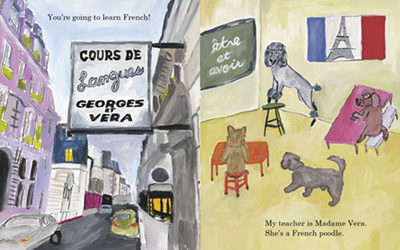
In Paris-Chien (a pun on the French word parisien--OK, it took me a few minutes to get that one, and you have to pronounce Paris in French--par-ee--for it to work!), we meet Hudson, an adorable Norwich terrier who has recently moved to Paris with his American owner.  However, adjusting to a new culture is apparently as difficult for dogs as for people--Hudson didn't realize that French dogs spoke French rather than "dog"!  But no worries, his owner enrolls him in French language classes, taught by Madame Vera--a French poodle.  Soon Hudson is as happy as a clam--or maybe a baguette or croissant--in his new home, and even has a French girlfriend!


This is a delightful book that is sure to please dog lovers and Francophiles alike.  The book is peppered with French phrases, which are translated in a "petit dictionnaire" in the back (although there is no phonetic translation, so the author seems to assume that the readers will already know a little French).  Children and adults alike will enjoy the "fish out of water" story of Hudson adjusting to Paris, told with a gentle sense of humor.  The gouache artwork is particularly charming, and the color palette and flat, stylized technique evoke 20th century French artists such as Matisse.

Author Jackie Clark Mancuso was inspired to write this book by her own experiences as an ex-pat in Paris.  Hudson is a real dog, and you can learn more about him on his Facebook page.


Wednesday, September 19, 2012

Book Review: Mira's Diary: Lost in Paris, by Marissa Moss (Sourcebooks, 2012)

Recommended for ages 9-14.

Author-illustrator Marissa Moss has two excellent new historical fiction novels for young people out this fall:  Mira's Diary: Lost in Paris and A Soldier's Secret.  Today I will be reviewing the first of these, and a review of the Civil War historical thriller A Soldier's Secret will be coming next week in my blog.

In Mira's Diary, Moss creates a time travel story melding the exciting artistic world of 19th century Paris with the shocking political intrigue and anti-Semitism of the infamous Dreyfus affair.  Although the Dreyfus affair is well known to those interested in French history, it's certainly not a topic most young people in the U.S. will be at all familiar with, and I applaud Moss for choosing to set her story around this important tale of corruption and scapegoats.

Our story begins when young Mira receives a strange postcard of a gargoyle from Notre Dame in Paris from her mother, who has been missing without any explanation for many months.  Not only is the black and white postcard very old-fashioned looking, so is the faded French stamp.  And "who sends postcards anymore?," wonders Mira.

With the postcard their only clue, Mira, her father, and her 16-year old brother take off to Paris, hoping to find her mother.  They check into a quaint hotel in the Marais, Paris' historic Jewish quarter, before going off to explore the famous cathedral.  Mira can't help looking everywhere for her mother, but it's not until she touches a gargoyle on the top gallery of the cathedral that she realizes she's been looking in the wrong century!  Magically transported to April, 1881, Mira not only befriends a good-looking young man who turns out to be an assistant to the famous French artist Degas, she also finds herself embroiled in the Dreyfus affair, a political scandal that involved the French army and virulent anti-Semitism in the French military and society at large.  Mira spots her mother several times, and receives several mysterious and secret notes from her.  It's clear that her mother is in danger, and Mira must step up to try to keep Dreyfus, a Jewish army officer, from being unjustly punished as a traitor.

This novel manages to mix very serious topics such as prejudice and anti-Semitism with an up-close look at late 19th century Parisian artistic life, letting us visit Giverny, Montmartre, the Impressionists Exhibition, and Parisian salons populated by famous artists such as Degas, Monet, Seurat, and Mary Cassatt.  Moss even throws in a hint of romance between Mira and Degas' handsome young assistant Claude.  Although readers will learn a lot about history and art through this book, they will also be entertained by the suspenseful story featuring a likable heroine who finds herself in a difficult--and certainly unusual--situation.

In the manner of her Amelia's Notebook series and her historical journals, Moss gives this new book the feel of a real journal or diary, from the cover with its mock journal binding to the charming small pencil sketches distributed liberally throughout the novel and the endpapers decorated with Mira's notes to herself, a map of France, and French vocabulary.

An extensive author's note provides a detailed explanation of the complexities of the Dreyfus affair (geared for tween readers) and the military corruption and anti-Semitism it exposed in 19th century Paris.  Moss also provides brief notes on Paris in the late 19th century, the impressionist art movement, and author Emile Zola, who wrote the famous "J'accuse" newspaper article in favor of Dreyfus.   A bibliography lists other resources and books consulted by the author.


Thursday, September 6, 2012

Book Review: The Time-Traveling Fashionista at the Palace of Marie Antoinette, by Bianca Turetsky (Poppy/Little Brown, 2012)

Recommended for ages 10 to 14.

In the second in her series about a fashion-obsessed middle-schooler who time travels by trying on vintage clothing, Bianca Turetsky turns to the court of Marie Antoinette, who was truly a fashionista before the word was coined.  Louise, our heroine, is once again invited to a vintage sale by the Traveling Fashionista, the same store she visited when she mysteriously time-travelled to the Titanic's maiden--and only--voyage.

Louise's father, an attorney, has recently lost her job, and now Louise can't go on her French class trip to Paris.  But no worries--Louise is about to have a much more exciting adventure than a class trip.  When Louise visits Marla and Glenda's mysterious vintage shop, which is located on a street that doesn't appear on any maps, she tries on a delicate blue satin ball gown, a genuine Rose Bertin.  Although the designer's name means nothing to Louise, Rose Bertin was dressmaker to Marie Antoinette, and as soon as Louise tries on the gown, she is magically transported to Versailles.  There she becomes Gabrielle, the Duchesse de Polignac, and the dear friend of a pretty blonde teenager that Louise soon figures out is the doomed Marie Antoinette.  Can Louise open Marie Antoinette's eyes to the suffering of the French people, and maybe save her life in the bargain?  And will she be able to get back to the 21st century in her magic dress?

I loved the premise of this book, since my #1 time-travel destination would be to the court of Marie Antoinette, but I could not help but be disappointed in many aspects of the execution.  Marie Antoinette was indeed the "Queen of Fashion" (see the excellent biography by historian Caroline Weber, Queen of Fashion: What Marie Antoinette wore to the Revolution), and in that sense a trip to her court is a perfect match for this fashionista series.  But I was troubled how Turetsky plays fast and loose with historical timetables, which bothers me in historical fiction, particularly for kids, where they might not know the historical facts.  For example, although no date is given, Louise remarks that Marie Antoinette is not much older than she is, so we can assume it takes place around 1770 --the year she marries the heir to the French throne, Louise-Auguste.  Turetsky repeatedly refers to Marie Antoinette's husband as Louis XVI, although he didn't take on that title until the death of his grandfather, Louise XV, in 1774.  She also has Louise turn into the Duchesse de Polignac, a very close friend of Marie Antoinette, but one whom she didn't even meet until 1775.  Also, Marie Antoinette is depicted as being unpopular with the French people, a development that happened much later in her reign.  And when they visit Marie Antoinette's dressmaker, they come home with boxes full of clothes, which were all made to order in those days.  Perhaps some of these details are cleared up by the author in a "Historical References" section, which did not appear in my advance copy, but I think if the author wanted to include some of these characters and events that take place closer to the French Revolution, she ought to have set the story a bit later, to keep the historical timeline more accurate, even if that would have made Louise and Marie Antoinette not quite so close in age.

An element of the book that I very much admired are the abundant fashion illustrations, done by fashion illustrator Sandra Suy.  They will be in full-color in the final version, although I had to make do with black and white in my advance copy.  The style reminded me very much of the vintage Barbie illustrations from the late 1950's and early 1960's, and fit very well with the Rococo style of the 18th century clothes.

Despite my criticism of the historical misrepresentations in this book, I do think that tween girls will enjoy this time travel adventure.  For those tweens who want to learn more about the endlessly fascinating Marie Antoinette, I would recommend the recent book by Carolyn Meyer, The Bad Queen:  Rules and Instructions for Marie Antoinette, a perfect match for that age group.

Monday, May 14, 2012

Book Review: The Queen's Lover: A Novel, by Francine Du Plessix Gray (Penguin, 2012)

For ages 14 and up


I have long been fascinated by Marie Antoinette and her family, an interest dating back to when I was around 12 years old.  I was therefore really looking forward to reading this new novel about Count Fersen, who was perhaps the secret love of Marie Antoinette's life and the architect of the failed escape plan to Varennes, after which the royal family was captured and imprisoned in Paris. However, I found this entire novel a huge disappointment.  The story is told in the first person by Fersen himself, as a sort of memoir, with other parts narrated by his sister when it was inconvenient to have Fersen himself narrate.  


The novel added little to my knowledge or understanding of these important historical figures.  Moreover, I didn't feel the author captured any real chemistry between Fersen and Marie Antoinette.  There are some very racy sex scenes with the two of them which frankly I found very distasteful--it gave me a feeling of being a voyeur at the scene which rather than being titillating seemed simply tacky. In addition, Fersen comes across as a very unpleasant person--it was hard to even empathize when he himself is beaten to death by an anti-royalist crowd in Sweden some years later. The book was clearly carefully researched, with the author using primary sources, but the way the author incorporated actual parts of letters written by Fersen and others made the book very awkward--was she trying to write a novel, a biography, or a history book? It seems like she couldn't decide, and it's a messy melange that doesn't work well. If you want to read about Marie Antoinette, check out instead Abundance, by Sena Jeter Naslund, a much better novel, or Queen of Fashion, an excellent nonfiction biography by historian Caroline Weber.


Marie Antoinette, by court painter Vigee-LeBrun

Wednesday, March 21, 2012

Book Review: The Academie, by Susanne Dunlap (Bloomsbury, 2012)

Recommended for ages 12 and up.


Susanne Dunlap is a favorite author of mine for YA historical fiction with a romantic flair, books that will realistically appeal much more to girls than to boys.  This is her fourth YA title (she has also written historical fiction aimed more at adults) and the first set in France.

In this new novel, Eliza, the young daughter of future U.S. President James Monroe, is in France with her mother, where she is left behind in a chic boarding school just outside the city that's run by a former courtier to Marie Antoinette, Madame Campan.  The school is attended by France's finest young ladies, including Caroline Bonaparte, the youngest sister of the up-and-coming French general, as well as Hortense Beauharnais, the daughter of Napoleon's wife, Josephine.  The book is set in the turbulent year 1799, the year in which Napoleon overthrew the French Directory and took power for himself as First Counsel, leading of course to his eventually crowning himself Emperor (although not in the course of this novel).

The book alternates between four different narrators:  Eliza, Hortense, Caroline, and Madeleine, the mixed-race--and of course entirely unsuitable--daughter of a cruel, drug-addicted Paris actress. Eliza quickly picks up on the bad blood between Hortense and Caroline at school, wondering what role she will play in the school's hierarchy of students.  All the girls seem much more concerned with their love lives than any studying, not too surprising since their primary curriculum seems to be learning how to talk prettily to young gentlemen, including the lads from the nearby boys' school who sometimes visit for training exercises.  But the school's far from boring.  There seems to be plenty of intrigue, with Caroline whisking innocent young Eliza off to a clandestine party in Paris when they're supposed to be asleep in bed.  All the girls develop crushes on the wrong sort of man--Hortense on a music teacher, Caroline on a general that her brother doesn't want her involved with, and both Eliza and Madeleine, the actress' daughter, on Hortense's handsome brother, Eugene.  Will anyone wind up with the man of their dreams?  You'll have to read on to the shocking ending to find out.

And in the middle of all of this romantic drama, there's a political drama behind the scenes, a possible coup, one that the girls are determined to witness, even dressing up as soldiers to sneak off and see what's going on.  Not to mention Eliza's trying to come to terms with her racial attitudes from growing up with slaves on a Southern plantation.

Although I greatly enjoyed The Academie, I can't say it's my favorite of Dunlap's novels.  I found it occasionally confusing switching back and forth between the different narratives, and I found it hard to suspend my disbelief at some of the girls' dangerous antics, which seemed a bit far fetched for young girls in this setting.

An author's note explains that while all three of her main characters (Eliza, Hortense, and Caroline) indeed attended the same boarding school, they were probably not all three there at the same time and the author admits to taking some liberties with the actual timeline in structuring her story.  Nonetheless, the real Eliza and Hortense remained friends and Eliza even intended Napoleon's coronation as emperor in 1804.  And the rivalry between Napoleon's family and Josephine and her children is a well-established historical fact.

This novel is set at a time period we don't see portrayed much in historical fiction--after the French Revolution, but before Napoleon fully takes power.  For that reason alone, I would recommend this book.  I think young people, particularly girls, will enjoy the romance and political intrigue that Dunlap skillfully portrays in this school setting so different from today.

Tweens and teens wanting to learn more about the real Napoleon might enjoy the lavishly illustrated
Napoleon:  The Story of the Little Corporal, by Robert Burleigh (Abrams, 2007)


Teens might also enjoy Betsy and the Emperor, by Staton Rabin (Margaret K. McElderry, 2004), which tells the story of a young girl who gets to know the famous man while he is a prisoner on St. Helena.


HARD TO BELIEVE, BUT TRUE:  I was stunned to read in the LA Times (see link below) recently that there are plans afoot in France to make a Disneyland-like theme park based on Napoleon, complete with snowy battle re-enactments and a ride on Napoleon's hat. What will be next?  An amusement park with a pretend guillotine where you get your head cut off and then reattached???

Tuesday, February 14, 2012

Book Review: Boys of Wartime: Michael at the Invasion of France 1943, by Laurie Calkhoven (Dial Books for Young Readers, 2012)

Recommended for ages 8-12.


Release date:  February 16, 2012


Check out my interview with author Laurie Calkhoven on February 16!


Twelve-year old Michael, a half-American, half-French boy living in Paris, has to grow up quickly when the Nazis invade France in this fast-moving historical fiction novel about World War II.  His brother's been captured and is in a German POW camp, and his father is in England, leaving Michael the man of the house for his mother and little sister.

Despite having to deal with hunger and the intense cold, Michael is determined to fight the Nazis in whatever way possible, and soon is a member of the French resistance.  Michael's assignment is dangerous but important--helping to guide Allied pilots to safe houses so that they can escape and continue to fly missions against Hitler.  But when the Gestapo discovers their cell of resistance fighters, will Michael be able to get his American flier and his family to safety?

This is the third in Calkhoven's excellent historical series Boys of Wartime (the first two novels were set during the Revolutionary War and the Civil War).  Told in the first person, the suspenseful story grabs the reader from the start, and I found the novel difficult to put down.  Michael is a well-rounded character, filled with doubts about his ability to live up to his father's expectations, yet brave and quick on his feet.  The narrative is peppered with telling details of the difficulties of life for ordinary Frenchmen under the Germans, from having to sleep in the Metro station because it was marginally warmer underground to breeding rabbits in the bathtub to have additional food to eat and to trade on the black market.

The author provides a prologue setting the scene for the story, providing easy-to-understand background on the beginnings of World War II and Hitler's Blitzkrieg.  A historical note at the conclusion provides further information on resistance groups, the role of children in the French Resistance, a timeline of the war, a glossary of unfamiliar words, suggestions for further reading about World War II, and brief biographies of some of the historical figures who are mentioned in the novel, such as Charles de Gaulle and Marechal Petain.

While there are many novels for young people about World War II, Calkhoven concentrates on a different angle--the rescue of American and allied airmen who were shot down in German-occupied airmen.  This was a subject I had never read about, and it made a very appealing narrative for young readers, full of danger, suspense, villains and heroes.  I would highly recommend this novel for collections for elementary school students and even for middle school.  The book, while clearly aimed at boys, would appeal to young girls as well who are looking for a story with plenty of action and adventure.


Disclosure:  Review copy provided by publisher.

Tuesday, November 22, 2011

Book Review: The Last Musketeer, by Stuart Gibbs (Harper Collins, 2011)

Recommended for ages 8-12.

As a Three Musketeers fan since I was twelve years old, I was of course excited to read this new time travel story, in which a 21st century boy travels back to France of the early 17th century, befriending the future musketeers, Athos, Porthos, and Aramis.  Author Stuart Gibbs' fast paced, action-packed tale may well appeal to today's tweens, but I couldn't help but be disappointed in the way he interprets Dumas' classic story for the 21st century.

The story starts off strong, with a terrific first sentence that will grab any young reader:  "Clinging to the prison wall, Greg Rich realized how much he hated time travel."  On a trip to Paris with his family to sell the family's treasured heirlooms to the Louvre, Greg and his parents are pulled through a time warp, winding up in 1615.  When his parents are falsely imprisoned for trying to kill the young Louis XIII, Greg must rescue them--by meeting up with three teenagers like himself, Aramis, a young cleric, Athos, a soldier from the lower social classes, and Porthos, a foppish rich young nobleman who's the life of the party.  Greg himself becomes known as D'Artagnan (in the original a fish-out-of-water himself, as a bumbling, hot-headed young man from the distant province of Gascony.  Mix in a nefarious brother of Cardinal Richelieu (the Cardinal being a central character in Dumas' novel), and a young Milady de Winter (the original villainess in the Three Musketeers), some tropes of fantasy fiction (a stone that grants eternal life), and voila!  a 21st century musketeer rehash.


Gibbs does a good job with the whole fish-out-of-water time travel tropes, with Greg disgusted by the smells of Paris, the privies, and the fleas, among others.  The book of matches in his pocket make the 17th century characters he meet think he's a magician, as does his ability to swim.  There's plenty of action, as Greg and his new-found friends swashbuckle their way to saving Greg's parents.  At the end, they don't go back to the 21st century, which makes me think that Gibbs has a sequel up his sleeve.

While I can't help but appreciate any author that brings Dumas' characters to the attention of 21st century kids, I couldn't get over several changes to the original story that drove me crazy.  First of all, the author keeps referring to Greg being in medieval Paris.  While the streets of Paris might have been similar to the way they were in the Middle Ages, 1615 is definitely not considered the Middle Ages, and I wonder how such a glaring error could have escaped the Harper editors, not to mention the professor of French history who Gibbs thanks in his acknowledgment for vetting the manuscript.  Second, and what bothered me more as a fan of the original novel, which I couldn't help wondering if Gibbs had actually read, he changed many key elements of the musketeers' personalities.  For example, Athos, or the Conte de la Fere in the original, was a member of the nobility, not a common soldier, as Gibbs makes him out to be.  Appearing as a young girl, the character of Milady de Winter doesn't make sense with that name, since she is supposed to have married an English lord after having been married to Athos as a young girl.  Also, it's not very believable that 14-year old boys would be made guards of the king!  Any young person who reads this and goes on to read the original Dumas is going to discoverer the many inconsistencies, which I just don't think were necessary.   And by turning the somewhat ordinary Greg into D'Artagnan, Gibbs eliminated one of the funniest and most memorable characters in the book, the young Gascon around whom the plot unfolds.

In short, while I enjoyed the concept of this story, I believe the execution could have been much better, simply by keeping more to the original outlines of Dumas' immortal characters.  Unfortunately, I don't think that Gibbs' changes to the basic characters really added to the story, but rather detracted from it.  It will be interesting to see if a sequel is in the making.


Has anyone seen the new 3-d Musketeer movie?  I haven't yet, discouraged by the terrible reviews!  My favorite film version is still the Richard Lester version with Michael York, Richard Chamberlain, Faye Dunaway, and others from 1973. Although this version made changes from the original, it was very much in the sprit of the original novel.


Wednesday, October 26, 2011

From the Backlist: For Freedom: The Story of a French Spy, by Kimberly Brubaker Bradley (Delacorte Press, 2003)


      Recommended for ages 10-14 

The Fourth Musketeer has been very busy finishing up her library school e-portfolio (now waiting for review by her advisor) and has not had as much time for blogging lately.  Now that her school work is finished, she will be back to blogging about historical fiction again:  all for one, and one for all!
Today, I am pleased to feature an excellent backlist title about World War II by Kimberly Brubaker Bradley.  I am looking forward to reading her newest book, Jefferson's Sons (on my list to find from the library!), which has had excellent reviews so far. 

Based on a true story, For Freedom tells the tale of 13-year old Suzanne, an aspiring opera singer and student in Cherbourg, France.  When the Germans bomb her town, she and her best friend are injured and witness the horrible death of a neighbor.  Rather than give in to fear, Suzanne becomes a spy for the French resistance, carrying messages that help the Allies plan the invasion of Europe.  Her work is extremely dangerous and often terrifying, and she is one of the few operatives from her unit to survive the war.  Not even her family can know about her dangerous work.

This novel is an excellent first-person narrative of an ordinary teenager who discovers an inner courage that helps her to play a part in defeating the Nazis, even though she must keep her role a secret from all her family and friends and pretend to carry on as normally as possible.  This novelization of a true story is very suspenseful and a great book to recommend to students since it has a very positive message of how a young girl could demonstrate great courage in extraordinary circumstances.

This book could easily be featured in a display or perhaps a book talk about spies, a subject very popular with young people.  Couldn't you just imagine: Beyond James BondSpies Real and Imaginary.  A great book talk for teens or tweens!  

What are some of your favorite spy stories for young people?  Please leave your favorites in a comment below.

Monday, August 22, 2011

Book Review: Becoming Marie Antoinette, by Juliet Grey (Ballantine Books, 2011)

Recommended for ages 14 to adult.

I am a bit obsessed with the tragic tale of Marie Antoinette, the epitome of the doomed Queen, and I'm clearly not the only one; her fascinating life continues to inspire novels, movies, and more.  The newest novel about her is the first in a planned trilogy by debut novelist Juliet Grey.  The first novel begins in 1766 at the court of Maria Theresa of Austria, the Hapsburg empress who was Marie Antoinette's mother, and ends in 1774 with the ascension to the throne of France of two teenagers, Marie Antoinette and her husband, Louis Auguste. The next book, "Days of Splendor, Days of Sorrow," is due out in 2012, with the third part appearing in 2013.

The book is narrated in the first person by Marie Antoinette herself, much like Carolyn Meyer's recent Young Royals treatment of Marie Antoinette, The Bad Queen, reviewed here at the Fourth Musketeer last year.  Grey establishes then Maria Antonia's happy childhood, frolicking with her many siblings at the Austrian court, which was much less formal than the etiquette-dominated splendors of Versailles.  When Marie Antoinette is matched up with Louis XV's grandson, her life changes even before her marriage; she is expected to be completely transformed in order to be suitable as the Dauphine and future queen of France, from her education to her hairline to her teeth (she was even given braces, which in the 18th century sounds like some kind of torture!).

Grey paints a very sympathetic portrait of the young Marie Antoinette, totally naive and unprepared for the intrigue of the French court, where she soon becomes a pawn in a game played by the king's maiden daughters (the "aunts") who conspire against the king's low-born mistress, Madame Du Barry.  With no real friends, no privacy, and little support from her awkward husband, Marie Antoinette is expected to dominate the intricate court life, guided by conflicting advice from her mother in Austria and the "aunts."  We can't help but feel sorry for this pampered princess, who enters France on her wedding voyage from Austria to the cheers and love of the French people but who later becomes the target of their hatred and vitriol.  How this transformation occurred with undoubtedly be covered in the next two volumes of this trilogy.  

Although published for adults, this engaging book is suitable for teens as well, especially those with a strong interest in history. There is some frank discussion of sexual intercourse (or lack thereof, since Marie Antoinette's husband was unable to consummate their marriage for many years, much to the dismay of not only Marie Antoinette, but everyone at court, where everyone knew of the lack of activity in the marital bed).  My own teenage reviewer found the book "too long and too detailed," but otherwise "fun."  She gave it 3 out of 5 stars, mostly because of the length.

Grey includes a detailed bibliography of sources she consulted.

Friday, April 15, 2011

Book Review: Madame Tussaud: A Novel of the French Revolution, by Michelle Moran (Crown, 2011)

Recommended for ages 14 to adult.


Everyone's heard of the famous Madame Tussaud's wax museums, which started in London but now have locations around the world, but how many of us know the thrilling story of the real Madame Tussaud? This novel, which was published for adults but would make an excellent choice for teen readers as well, concentrates on the life of young Marie Grosholtz in Paris and Versailles during the turbulent years of the French Revolution.

Marie lives with her mother and uncle, studying under her uncle's tutelage how to make figures for their famous Salon de Cire, or wax museum, which includes tableaux with statues of everyone from the King and Queen having a meal to the Cavern of Great Thieves, made to look like a dungeon.  Her uncle hosts one of the city's most popular salons, whose regulars include the Duc d'Orleans, the king's radical cousin, Jean-Paul Marat, Robespierre, and others who are soon to become famous--or infamous--as revolutionaries.  Her brothers guard the king as part of the Swiss Guard at Versailles.

Madame Tussaud's death masks
When the novel opens, a letter has just come from the King and Queen, saying they want to visit the Salon!  Although Marie knows that the Queen has recently been plagued by scandals, she is convinced that their visit will bring good fortune.  What she can't imagine at that moment is that she will be invited to move to Versailles to instruct the king's sister, Madame Elisabeth, in the art of wax modeling, and that her life will become intimately linked with that of the royal family.  Never could she have guessed that within a few brief years, she would be required by the revolutionaries to make wax reproductions of the bloody heads of their victims, some of whom she knows personally, to be paraded through the streets of Paris.  If she doesn't do their bidding, her head is likely to be the next to fall under the guillotine's sharp knife...will she be able to survive the Revolution with her own head intact?

This novel is historical fiction at its best--a fascinating tale filled with real historical characters, told by a skilled storyteller.  Moran weaves a tantalizing tale that takes us from the richness and splendor of Versailles (complete with the stench of the hallways) to the heights of the Terror.  Although I have read many novels set during this period, as well as nonfiction about the French Revolution, I couldn't help but gasp at some of the horrors Marie was forced to endure.  There's some romance, too, of course, for Marie, but it's secondary to the political tale.

Highly recommended for teens and adults!

Library Journal published an interview with the author, Michelle Moran, whose previous novels all were set in ancient Egypt.

A film on Madame Tussaud's life has recently been announced, to be produced by Stephane Sperry and Liaison films.  I'm looking forward to that one!

Wednesday, September 15, 2010

Book Review: Revolution, by Jennifer Donnelly (Delacorte Books, 2010)

Recommended for ages 12 and up.


Jennifer Donnelly's newest novel weaves a spell on its readers with its riveting genre-busting blend of realistic contemporary young adult fiction, historical fiction, and even some paranormal fiction tossed in the mix.  It's the story of two fascinating young women, Andi and Alex, who live more than two centuries apart, but whose lives intersect at the close of this compelling tale.


We start out meeting Andi, a brilliant but very troubled high school senior who attends a ritzy prep school in Brooklyn; an incredibly gifted guitarist who lives for music, she is in a deep depression, tottering on the edge of suicide despite psychiatrists and pills, since the death of her younger brother, Truman, a death she feels responsible for.  Her parents' marriage has fallen apart; her father's a Nobel-prize winning geneticist responsible for unraveling the mysteries of the human genome, while her mother is a talented French artist who paints non-stop to cope with her young son's death.  When her father says she's going with him to Paris over Christmas break, she's not happy about it, but goes along to start researching her senior thesis about an 18th century French composer and guitarist.  Her father is called to Paris to analyze the DNA of an old heart believed to belong to Louis Charles, Dauphin of France and son of Louis XVI and Marie Antoinette, who was believed to have died in the Tower during the French Revolution.  Some believed the young boy might have escaped, and Andi's father and his historian friends intend to put the mystery to rest with 21st century technology.

This all seems to have little to do with Andi and her problems, until, hidden in an old guitar case, Andi finds a portrait--one that looks much like her brother, but was clearly painted long ago.  In the case is also an old diary, dated April 1795.  This is the diary of Alex, who talks about a prisoner in a tower...sure enough, the portrait is of Louis-Charles, the Dauphin.  Reading the diary, Andi discovers the life of Alex, a young actress who dreams of a career on the stage, but through a twist of fate, becomes a companion to Louis-Charles at Versailles and later in Paris.  Through her diary, we experience the progression of the French Revolution, the hope and then the despair as Robespierre and the Jacobins launch the Terror.  Alex's love for the Dauphin, taken forcibly from his mother to be educated as a "good Revolutionary," causes her to endanger her own life to try to free Louis Charles, and finally, to provide the abandoned prince with some hope and light.

Andi's contemporary voice is interrupted with excerpts from Alex's diary, which we read along with Andi as she becomes more and more drawn in to the diary.  Donnelly skillfully creates distinct voices for both characters which suit their personalities and time periods.

All teen novels seem to need at least a bit of romance, and in this novel we have a relationship between Andi and a handsome young French guitarist and rapper whom she meets while performing on the street.  This character, who is of North African background, adds another element to this rich story, as Donnelly touches on the racism and poverty of these immigrants who live largely in housing projects in the Paris suburbs.  But when Virgil takes Andi to a party in the depths of the Paris catacombs, she meets a "hot goth" guitarist, who leads her into a part of the catacombs where tourists can't go.  When they exit the catacombs, things get really strange--"the men all have ponytails.  All of them."

It turns out Andi has wound up in the Paris of the Revolution, with the very musician whom she is researching for her thesis.  But is she Andi, or Alex?  And will she be able to get back to her 21st century life?

This is such a fascinating novel on so many levels, and its blend of different genres should make it an easy sell to students who might not usually pick up a historical novel.  Not only are both girls great characters, Donnelly melds the stories together in a highly creative way.  When I first started the novel, I wasn't sure if the two-story approach was going to work, but I was entirely convinced by the end.

For those who enjoy this book, a great novel to pair with Revolution would be The Bad Queen:  Rules and Instructions for Marie Antoinette, by Carolyn Meyer (Harcourt, 2010).  For teens willing to tackle a longer book, Abundance:  A Novel of Marie Antoinette by Sena Jeter Naslund (William Morrow, 2006), is an engrossing fictional "diary" of the queen.  

Although the French Revolution is one of the most written about subjects in history, there don't seem to be a plethora of excellent non-fiction books about the subject written for young people here in the U.S.  Some of the more promising titles include:

Marie Antoinette, and the Decline of the French Monarchy, by Nancy Lotz (Morgan Reynolds, 2004) and
Louis XVI, Marie Antoinette, and the French Revolution by Nancy Plain (Marshall Cavendish, 2001).

However, there are several excellent documentaries that are available from libraries or Netflix:  I would particularly recommend The French Revolution, a History Channel Documentary from 2005, which provides a good overview of the revolutionary period, or for more on the doomed royal family, Marie Antoinette:  A Film by David Gruber (2006), available from PBS Video.  Teens might also enjoy the 2006 Sofia Coppola film Marie Antoinette (which includes only the early days of the revolution, ending when the royal family leaves Versailles).


Release Date:  October 12, 2010

Friday, August 6, 2010

Book Review: Resistance: Book I, by Carla Jablonski and Leland Purvis (First Second, 2010)

Recommended for ages 12 and up.


The variety and quality of graphic novels for both young people and adults that are published in the U.S. and abroad is growing every year, and Resistance, the first in a new trilogy of graphic novels about the French Resistance during World War II is a worthy addition not only to graphic novel collections but also to the wealth of Holocaust literature for children and teens.


The author opens the story by providing some necessary historical background on the Nazi innovation of France in 1940 and the subsequent division of the country into Occupied France, run directly by the Nazis, and "Free France," run by the Vichy government, who collaborated with the Nazis.  Paul, a budding artist, his sister, Marie, and his mother live at the Hotel Tessier; Paul's father is a prisoner-of-war.  Paul's own drawings, with ragged edges that make it look as if they were torn straight from his sketchpad, provide a running commentary on the plot, and are interspersed with the story panels, offering his personal insights into the characters he encounters.  

However, Paul's problems are nothing compared to those of his friend Henri Levy, a Jew who they hide in their wine caves when the Nazis take over their hotel.  As the Nazis begin deporting Jews and closing Jewish businesses in the Occupied Zone in 1942, Paul, Marie and the other children in the town struggle to understand what is going on.  "Is it bad to be Jewish?" Marie asks her brother.  "Of course not," he replies, but he's unable to explain to her why the Jews are being taken away.

When Paul learns of the secret Resistance movement fighting in many ways against the Nazis, he wants to help.  While initially he's told he's too young, the local leader realizes that young children could be perfect for transporting information, since no one would suspect them.  Soon they are given a test, to see if they are trustworthy.  Paul's drawing talent even comes in handy, when he is asked to draw vehicles the Nazis have at the hotel and anything that they install on the grounds.  Quickly they are entrusted with a dangerous mission--transporting information to Paris right under the Germans' noses--and helping their Jewish friend Henri locate his parents.  

The suspense builds on the train ride, as violence erupts.  Will Marie and Paul be able to complete their first mission successfully?

Jablonski does a terrific job in recreating the confusion and moral ambiguity of the period.  In a thoughtful Author's Note at the conclusion of the story, she discusses the role of ordinary people who took action against the Germans to liberate France.  However obvious right and wrong seems to us now, Jablonski points out that there "are different versions of 'the truth,'...History as lived is anything but clear!...what seems obvious to us now was probably not at all obvious to anyone then."  She emphasizes the difficulty of making choices--even if that choice was doing nothing.  Purvis' illustrations, ranging from his grim depictions of Nazi roundups and deportations, colored in dark tones of blue and gray, to the angst-filled expressions on the passengers' faces while having their documents inspected by Nazi soldiers on the trains, greatly enhance the suspense and drama of the story.

Jabonski is the author of numerous other novels for teens and middle-grade readers, and she is also an actress, playwright, and trapeze performer (!)  Purvis has illustrated numerous other graphic novels for young readers, including several historical fiction titles.  

There are not a large number of graphic novels for young people focusing on this period; however, teen readers who are interested in the period might want to read the graphic novel classic Maus I:  A Survivor's Tale, by Art Spiegelman; younger readers (9-12) may want to consider the graphic novel Goodbye Marianne:  A Story of Growing Up in Nazi Germany, by Irene Watts and Katherine Shoemaker (Tundra Books, 2008).

Two other excellent historical fiction titles for young people about the French Resistance are For Freedom:  The Story of a French Spyby Kimberly Brubaker Bradley (Laurel Leaf, 2005), and Sirens and Spies, by Janet Taylor Lisle (Aladdin, 2002).   These are both suitable for ages 10 and up.


On a related note, a graphic novel of the iconic Holocaust book, Diary of a Young Girl by Anne Frank, has just been published in Europe and will be published in the U.S. later this summer (see link below).

Related articles by Zemanta