Monday, October 3, 2011

Book Review: The watch that ends the night: voices from the Titanic, by Allan Wolf (Candlewick, 2011)


Release date:  October 11, 2011

Recommended for ages 10 and up.

What else could be left to say about the Titanic, we could wonder.  A quick WorldCat search for juvenile historical fiction about the Titanic turned up dozens of titles, including quite a few coming out in 2011.  I must be one of the few people around, at least over the age of 30, who never saw the wildly popular 1997 movie, but I was curious to read this new teen novel by poet Allan Wolf about the 1912 disaster at sea.  I am a huge fan of his 2004 novel, New Found Land:  Lewis and Clark’s Voyage of Discovery, which tells the story of the Lewis and Clark expedition in free verse from the point of view of fourteen participants, including Lewis’ dog, Seaman.  

Wolf’s new novel is in much the same format, alternating between the points of view of various crew and passengers of different social classes, including the ship’s captain, baker, wireless man, and the ship lookout; millionaire John Jacob Astor, who’s sailing with his teenage bride; the famous “unsinkable” Molly Brown; a beautiful young Lebanese immigrant sailing with her brother; a cardshark; a violinist from the ship’s orchestra; and even a rat and the iceberg itself.  In his research, Wolf sifted through the 2,000 passengers and crew to identify 24 different compelling and diverse stories for his narrative.  Each character writes in his or her own style, including the poems of the rat, which are written in concrete verse, and the poems are clearly labeled with the name of the character as a heading so threre’s no confusion for the readers.  The groups of poems are separated into different chapters, with the story told largely chronologically.

The novel begins ominously enough with the first poem coming from John Snow, an undertaker from Halifax who journeyed to recover bodies strewn in the Titanic wreckage.  We then skip to the prelude, where we meet the various colorful characters who will participate in the drama, beginning with the ship’s rat.  Even the iceberg in this book takes on a vivid personality through Wolf’s skillful writing.  Although we know the outcome from the outset, Wolf manages to create an atmosphere of suspense throughout, particularly as we see the many messages sent through the wireless from other ships warning of the massive icebergs in the vicinity.  Wolf takes the time to establish the atmosphere of “frivolous amuseument” on the giant ship, as the passengers promenade on the decks, partake of gourmet cuisine, and descend the grand staircases.  Even those in third class enjoy food better than they have ever eaten before.  

When the ship collides with the iceberg, the shipbuilder and captain quickly realize that the situation is hopeless and the ship will go down within two hours at the most.  The captain muses poignantly:

My God.

I was giving out orders left and right.  But I really had no plan...
Our only hope was an orderly evacuation and a passing ship,
a ship very close to give us time to shuttle the passengers...
Of course I knew the precise number of people on board.
I had signed the paperwork myself.  My responsibility.
Two thousand two hundred and eight souls.
Twenty boats.
The mathematical disparity stung my brain.
Regardless of how the rest of the story turned out,
I knew it must begin with filling the lifeboats with as many souls as possible.

We witness the evacuation of women and children, first class, then second class, and when the captain called for third class, there were no more boats.  As the ship collapses, passengers fall into the frigid Arctic water, and the poems evoke the horror of the sounds of those who die quickly of hypothermia as well as those who tried to climb onto the lifeboats.  Extensive back matter provides biographical details about each of the passengers included in the book, as well as an excellent bibliography.

Our fascination with this tragedy shows no signs of abating; in some ways it’s the ultimate man against nature story, as well as a tragedy of Greek epic proportions.  2012 is the centennial of the disaster, and not only should we expect numerous books, TV documentaries, and more, you can even take a cruise recreating the voyage. (one of the two cruises being offered is already sold out!)  The cruise includes a special memorial service at the exact spot of the sinking, the opportunity to wear period costumes and experience a selection of food and drinks served on the Titanic, themed entertainment, and a stop in Halifax to visit the cemeteries where victims are buried.  Apparently recreation of the collision with the iceberg is not included.  

What is your favorite book about the Titanic?  Please leave a comment with your response.  

Sunday, October 2, 2011

Nominate your favorite books for the Cybils Awards today!

Nominations for the 2011 Cybils awards are open!  The Cybils awards are given each year by children's and young adult book bloggers for the year's best children's and young adult titles.  This is the sixth year of the awards. If you'd like to nominate your favorite titles, surf on over to the this link.  Nominations are open from October 1 to October 15.  In order to be eligible, books must have been published between Oct. 16, 2010 and Oct. 15, 2011. This year, nominations for book apps for iPad, Web or computers are also being accepted. 

This year I am very excited to be serving as a second round judge for the Middle Grade/YA Nonfiction category!  I have read many terrific books in this category during the past year, and am looking forward to seeing what the first round judges pick as finalists. 

Tuesday, September 27, 2011

Thoughts on Banned Book Week

Monday was the start of Banned Books Week, a celebration of the freedom to read.  This annual event, launched in 1982 in response to a surge in the number of challenges to books in schools, bookstores and libraries. is sponsored by the American Library Association, the American Booksellers Association, the National Council of Teachers of English, and a slew of other worthy organizations. 

Why should anyone care about Banned Books Week?  I'd like to turn to YA author Ellen Hopkins, an author whose edgy teen books deal with drug addiction, prostitution, and other difficult issues.  I studied her works and life for a library school project, and was deeply moved by her fierce commitment to intellectual freedom and the freedom to read.  All her books have been challenged at one time or another, and, perhaps more shocking, she has been challenged as a speaker; in 2009 an invitation to speak at a school in Oklahoma was rescinded, as was an invitation to participate in a Texas Teen Lit book festival, after complaints by a few parents.

What does Hopkins have to say about challenging books?  She writes:

"I don't believe any one person should have the power to decide what everyone else does or does not get to read.  Every reader has a different life experience and what might be "too much" for one may speak loudly to another.  If you don't like a book, don't read it.   But don't dare try to speak for everyone else!"

If you'd like to participate in a fun way in Banned Books Week, check out the Banned Books auction of original children's books art, donated by an array of wonderful illustrators including Bruce Degen, Jon Agee, David Shannon, Anna Dewdney, and many more.  Also, you can join the virtual Read-out lasting all week, in which you can upload videos of yourself reading a banned book.

Hopkins wrote in her blog last year on the anniversary of September 11:
Words do have power. In America, the First Amendment grants us the right to believe, to worship, to speak our minds as we please. There is a responsibility that comes with that, however...too many of us word people find the easier path not to write with courage. Not to stand up for our beliefs. Not to push back against would-be censors or the people who use words to divide. I’m pushing back today, as a responsible American. This is my country, and I love it, and I love the freedoms it was founded upon. If you want to burn a book, it’s your right. Burn it. And I’ll keep writing new ones to replace it.
Thank you Ellen, and all those who fight against abridging one of our most fundamental freedoms--the freedom to read.

Monday, September 26, 2011

Nonfiction Monday Book Review: Kennedy Through the Lens: How Photography and Television Revealed and Shaped an Extraordinary Leader, by Martin W. Sandler (Walker & Co., 2011)

Recommended for ages 12 and up.

This handsome book equally suitable for young people or adults looks at one of our most popular presidents, John F. Kennedy, and the role photography and television played in shaping his presidency and his legacy.  An oversize book laid out with a series of two page spreads, the book provides not only fascinating text but a captivating graphic design.  Each two page spread has a different striking color scheme, with a quotation from JFK appearing in a colored box near the to of each spread.  And what president could be better suited to this photo essay format than the handsome, youthful Kennedy complete with his adorable children and beautiful wife?

Sandler explains how Kennedy was the first president to have an official White House photographer, and to permit informal photos throughout the White House, particularly private moments with his family.  He was also the first president to widely use color photography and to understand the power of television.  Reproduced are famous photos like John John hiding under the Oval Office desk, but also photos that were new to me such as a wonderful color photo of Caroline and John John dressed up in Halloween costumes and plastic masks, visiting their father in the Oval Office, and another with the two children leaping and dancing for their dad, who applauds them from a nearby chair.  And who can resist of a photo of JFK being nibbled on by one of Caroline's ponies?

But this book is not just a succession of charming photos of the Kennedys on land and sea.  There's also an overview of all key aspects of his life and presidency, from discussion of his privileged beginnings, his war service, the space race, Cuban Missile Crisis, civil rights, Vietnam, to his "secrets" (his extra-marital affairs and serious medical issues) to his assassination and legacy.  There's plenty of information for a school biographical report, but the book is also great for tweens and teens interested in history who would like to explore the life and legacy of this remarkable man.


Author Martin Sandler is the award-winning author of many books for young readers, including Lincoln Through the Lens and The Dust Bowl Through the Lens.
Enhanced by Zemanta

Tuesday, September 20, 2011

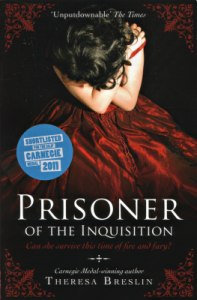
Book Review: Prisoner of the Inquisition, by Theresa Breslin (Corgi Books, 2011)

Recommended for ages 12 and up.

I don't usually order books from England before they are even available in the U.S., but when I read about Prisoner of the Inquisition in an article about England's prestigious Carnegie Award I couldn't help myself. Prisoner was short-listed for this year's Carnegie and won the Carnegie Shadowing Award (books chosen by young people who shadow the official judges and is written by a well-known author of historical fiction in her native Great Britain, Theresa Breslin.

One of my favorite historical fiction titles from back in my own teen days was Samuel Shellabarger's swashbuckling Captain from Castile, (adapted into a famous film with Tyrone Power), also set in the dark days of the Spanish Inquisition.  Scottish author Theresa Breslin's young adult novel focuses on some of the same themes of adventure, romance, revenge, and abuse of power by the church that I relished so many years ago in Shellabarger's novel.  In alternating chapters we meet two teenaged characters:  Zarita, the thoughtless, spoiled, only daughter of the wealthy town magistrate, and Saulo, son of a beggar.  Their lives intersect when Saulo's father, needing money to save his sick wife and hungry son, begs at the church where Zarita is praying, grasping her hand in desperation.  Saulo's father is soon cruelly executed for daring to assault Zarita, despite her pleas that the man does not deserve to die.  Saulo himself barely escapes the executioner's rope, and swears revenge on Zarita and her family.

Their stories are then told in parallel; Saulo is thrown into the harsh life of a galley slave, where through his wits, he is able to learn some navigation, is pursued by pirates, and eventually becomes acquainted with Christopher Colombus, a confident sailor from Genoa who hopes to gain patronage from the Spanish monarchs to explore an alternate route to the Indies.  Zarita, on the other hand, has troubles of her own.  The Inquisition has come to her town, and with it fear, suspicion, and cruelty.  No one is immune from the Inquisitor's tactics, even Zarita's aunt, a nun, a simple-minded relative, and Zarita herself.  Soon Zarita and Saulo's lives will intertwine again, in a way neither of them could ever have suspected.  Can they escape the dangers of the Inquisition?

I thoroughly enjoyed this historical novel about one of the darkest periods in Spanish history, although I found the transformation of Zarita's character from a self-absorbed young girl who thinks nothing of a poor beggar in the church to a kind, sensitive young woman a bit difficult to believe.  Some of the other characters in the book, including Zarita's young step-mother, are also somewhat one-dimensional, but the novel effectively captures the spirit of the period and is well worth reading.  I hope it will soon be released to an American audience.

Teens looking for other novels about this dark period in history may want to check out Alice Hoffman's Incantation (Harper Collins, 2004).

Monday, September 5, 2011

Book Review: Lights on the Nile, by Donna Jo Napoli (Harper Collins, 2011)

Recommended for ages 8-12.

Release date:  September 20, 2011

Ancient Egypt continues to hold great appeal for young and old, and even makes the best-seller lists (see Stacy Schiff's Cleopatra:  A Life, for example).  Award-winning author Donna Jo Napoli's newest book, suitable for elementary school readers, is set during that fascinating period, and tells the story of Kepi, a young girl living around 2530 BCE.  Kepi's father, a laborer, has been wounded during the construction of a pyramid for Pharaoh Khufu.  Kepi's life changes dramatically when she, along with her pet baby baboon, Babu, is kidnapped and hidden in a large basket on a boat.  Where is she being taken and what will become of them?  Babu, we soon discover, is destined to be sold to priests at one of the great city temples.  When she is separated from her beloved pet, Kepi decides she must go see the powerful Pharaoh to tell him about men who are getting injured building his pyramid.  Surely he will help these men and their families!  Kepi will need to draw on all her courage to try to reach the all-powerful Pharaoh.

Napoli makes the reader feel that she, too, is travelling down the Nile, with her vivid descriptions of the wildlife--oryx, pelicans, and the dangerous hippos, crocodiles, and other animals--temples, gods, and people of the region.  This is a quick-moving adventure story well-suited for middle-grade readers.  Here in California, ancient Egypt part of the sixth grade curriculum, and this would be an excellent book to recommend for children developing an interest in that period.  Many of the novels about this period for young people seem to involve Cleopatra; this new book makes a welcome addition to novels about the period, offering a story about an ordinary girl who takes an extraordinary journey.

One note:  the publisher's copy for this novel indicates that the story "revisits the fabled origin of fairies."  The end of the book does contain a fairy element (I won't go into the details here) but I would say that the fairy story is secondary in this novel to the historical fiction side.  I would not want to pitch this to children as a story about fairies, since fairies do not even come into the narrative into the very end.  A child expecting "Disney Fairies goes to ancient Egypt" will be very disappointed!


Disclosure:  Review copy provided by publisher.

Giveaway and Nonfiction Monday Book Review: Thomas Jefferson for Kids: His Life and Times with 21 Activities, by Brandon Marie Miller (Chicago Review Press, 2011)

Recommended for ages 9-14.

This new release from Chicago Review Press about Thomas Jefferson, one of the most venerated of our founding fathers, is a great addition to any school or public library, as well as ideally suited for  use by home schoolers.  Although many biographies of Jefferson are available for young people, this one is unique in including a variety of hands-on activities to enhance learning, from how to organize your library like Jefferson, how to observe the weather, grow a plant from a cutting, or paint a buffalo robe.  Although I did not try any of the activities, they include copious instructions, and are well suited for upper elementary and/or middle school students.

Organized chronologically, this book begins with some background on Jefferson's father, Peter, and his wife Jane.  Thomas was the first of their eight children, and showed himself to have a quick mind from his earliest childhood.  Jefferson went on to be a brilliant college student, often studying 15 hours a day (and without a tiger mother!), and then studied law.  We learn about Jefferson's immersion in radical politics, his family life, and his drafting of the Declaration of Independence.  Later chapters explore his presidency and his founding of the University of Virginia, as well as recounting the incredible story of his death on the 50th anniversary of the Declaration of Independence--the same day as his friend and rival, John Adams, also breathed his last.

Miller's volume is clearly written, and provides a fascinating look at this complex individual and his wide range of accomplishments and interests.  I particularly appreciated that she does not shirk from analyzing Jefferson's many contradictions, which she summarizes as follows:  "A man who believed in frugal government yet lived his own life burdened by debt.  A man who hated kings and privileged nobles yet lived as an aristocrat himself.  A man who believed passionately in freedom and liberty yet owned slaves who toiled for his comfort."

It is the last of these contradictions which is most difficult for us in the 21st century to come to terms with.  Although Jefferson recognized the evils of slavery and even condemned slavery in the first draft of the Declaration of Independence, these remarks were removed in one of 86 changes made by Congress.  Slavery, though, was deeply engrained in Jefferson's consciousness; he grew up in a slave-owning household, and inherited his first slaves when he turned 21.  Miller includes in her book an advertisement Jefferson placed to recover a runaway slave, describes what is known of his relationship with Sally Hemmings, including discussing the many children she bore him (a new historical fiction novel for young people, Jefferson's Sons, by Kimberly Bradley, comes out in mid-September, and will be reviewed here at The Fourth Musketeer later this fall).

This volume is greatly enhanced by an abundant use of illustrations, including many full page reproductions of paintings, photographs, maps, and drawings.  The large format of the book and generous use of white space make the text easy to follow, and the author makes good use of many sidebars for further explanations of different topics in Jefferson's life, from his slave Jupiter to the Hemming family to political explanations of events such as the Sedition Act.

Back matter includes places to visit and websites to explore, further reading for young people, a selected bibliography, and a detailed index.  A timeline of Jefferson's life is also included, as is a note to readers explaining how primary sources from Jefferson's life can include different spelling, grammar, and punctuation from what we are used to today.

Award-winning author Brandon Marie Miller has previously written numerous history books for young people, including similar volumes on George Washington and Benjamin Franklin (complete with activities).  She also blogs about books at the group blog Hands-on Books:  Nonfiction for Kids with Fun Activities.  

I am delighted to offer a copy of this book as a giveaway to my readers.  To enter to win a copy of this volume, please leave a comment below with your e-mail address so I can reach you if you are the winner.  U.S. only please.  A winner will be selected on September 15, 2011.

Those who plan trips to Washington D.C. may be interested in the just-announced news that the Smithsonian will be collaborating with Monticello on a new exhibit examining Jefferson's interaction with slavery.  "Jefferson and Slavery at Monticello:  Paradox of Liberty" opens January 27 at the National Museum of African American History and Culture gallery in the Smithsonian's National Museum of American History.


Disclosure:  Review copy provided by publisher.

Enhanced by Zemanta