Monday, December 12, 2011

Nonfiction Monday: Saga of the Sioux: An Adaptation from Dee Brown's Bury My Heart at Wounded Knee, by Dwight Jon Zimmerman (Henry Holt, 2011)

Recommended for ages 10 and up.

Unfortunately I've never read Dee Brown's iconic Bury My Heart at Wounded Knee, the best-selling history of the American West from the point of view of the Native Americans that was first published in 1971.  In this new book written for younger readers, Dwight Jon Zimmerman has adapted Brown's 500+ page book for a younger audience, adroitly simplifying but not "dumbing down" the complex and interwoven stories of the different Indian tribes in the original by concentrating on the Great Sioux Nation.  As Zimmerman explains in his preface, the Sioux's epic fight against the white man represents the struggle of all the Indian nations in many ways, and includes the stories of some of the most famous warrior chiefs in Indian history, among them Sitting Bull and Crazy Horse, as well as some of the most famous battles and events.

Zimmerman condenses and abridges Brown's work to concentrate on the Sioux' story, but also adds a first chapter providing background on the Sioux people as well as an epilogue discussing what has happened to the Sioux since the infamous massacre at Wounded Knee in 1890, and their attempts through the U.S. courts in modern times to get their sacred lands, the Black Hills, returned to them.

I must comment that I found this an incredibly difficult book to read; not because of complicated vocabulary or poorly written narrative, but because of the tragic nature of the material.  In fact, the book made me think about how many narratives of the Holocaust I have read, and yet how this tale of the white man's betrayal again and again of the Native Americans was so hard for me to digest.  That's perhaps a topic for another blog post, but even in stories (whether fiction or non-fiction) of the Holocaust there's a few good people who tried to rescue Jews or otherwise help them, whereas it doesn't seem like any of the white people appreciated the Indians' culture and lifestyle at the end of the 19th century.  Undoubtedly there must have been some more forward looking whites, but where were they?  Putting the Indian children into boarding schools to train them to be "white", it seems.

This narrative starts in the years leading up to the Civil War, in which the Sioux of Minnesota agreed in treaties to surrender nearly all their land, thus having to learn to farm like white men and depending on annuities from the government, and covers the story of the Indian Wars that ensued over the next thirty years.  Over and over again the Sioux were betrayed by the U.S. government, who would appear to negotiate treaties in good faith that they seemed to have no intention of keeping.  The narrative is magnificently illustrated with many full page photographs of various Sioux chiefs as well as American leaders, maps, as well as historic paintings and lithographs.  Zimmerman allows the Sioux leaders to tell their own stories, continuing Dee Brown's practice of including ample primary source materials (primarily oral histories).

Zimmerman concludes his narrative with the incredibly powerful quote that seems to sum up everything that happened to the Native population of this country from the time the white man first landed:

"They made us many promises, more than I can remember, but they never kept but one; they promised to take our land, and they took it."  --Red Cloud


This book includes abundant backmatter, including a timeline of Sioux history from 1851 to 1909, a glossary, information on the Sioux calendar, recommended reading, suggested websites, and an index.

I expect this excellent book to be nominated for many non-fiction awards; I would highly recommend it for upper elementary school through middle school, as well as for adults who would like an easy-to-follow overview of this shameful part of our nation's history.

Wednesday, December 7, 2011

Longing, Belonging, and Speaking out for Justice: Writing from Real Life (Guest post by author Katherine Schlick Noe)

author Katherine Schlick Noe
I am delighted to welcome debut author Katherine Schlick Noe to The Fourth Musketeer.  Katherine has kindly prepared a guest post about her first novel, Something to Hold, reviewed yesterday on this blog.

What was it like living on an Indian reservation?

For as long as I can remember, other non-Indians have asked this question.   It’s always been hard to explain.   Like all of the foundational, complex questions of our lives, there are many answers.   They finally began to solidify when I started to write Something to Hold.

This work of fiction is inspired by my memories of living on the Warm Springs Indian Reservation in central Oregon in the 1960’s.  Like Kitty’s dad, mine was a forester with the Bureau of Indian Affairs.  He and my mother left Iowa in 1950 to take a job on the Colville Indian Reservation in north-central Washington state.  They didn’t know then that they would spend the rest of their lives working with and living among Indian people.  My brothers and I were born on the Colville Reservation, and we moved every four years, living near Washington, DC and on the Warm Springs and Yakama Reservations.

The years at Warm Springs were pivotal for me, as they are for all children between the ages of seven and eleven.  Something to Hold is grounded in universals.  We all long to find a place to belong, to make friends, to feel connected and rooted.  The book also explores a unique perspective of a non-Indian outsider’s growing awareness of prejudice, including her own.

My writing began with one memory: In the fifth grade at Warm Springs, a classmate I both feared and admired refused to read out loud, and our white teacher took her out into the hall, shook her, and left her there.  Reading out loud, one paragraph at a time, was a normal practice in every school I had attended.  I hated it – so boring to listen to other bored kids read something boring – but I would never have refused.  I couldn’t understand why my classmate would defy this teacher, who allowed no disobedience of any kind, in this way.  That event had a profound impact on me and is one reason that I eventually became a teacher.  No child should be humiliated that way.


That event is also what moved me to write about living at Warm Springs. Having wrestled with the memory for over 30 years, I did what we encourage young writers to do -- started listing all that I could remember about it.  Then I began to tell the story. I was writing in order to make sense for myself, to understand why she would dare to do something I would never have had the nerve to consider. But, of course, I couldn’t remember everything, and that’s when the fiction took over. 

As Something to Hold took shape, I had a chance to meet my classmate again.  Both of us now grown, we visited over our class photo, talking about how life had turned out.  It was clear that hers had been filled with hardship, so different from my own.  When I asked her about the event that had affected me so deeply, she looked me in the eye and said, “It never happened.”  I knew in that moment that this was not my story to tell. So I took that episode apart, changed the details but kept intact the power and fear and strength of will – all of the emotions that were so influential for me -- and gave them to my two antagonists, Raymond and Jewel.  In the chapter “The Capital of Vermont,” Raymond and Jewel stand up to their teacher and triumph over humiliation.  And Kitty learns something powerful about speaking out for justice.

Many of the events in Something to Hold are based in truth.  The only way I could begin was to build Kitty’s story around my memories:  a Bible-quoting teacher, the death of a child, a boy who fell through the ceiling of my classroom while working in the school attic, how razor blades horribly derailed an art project.   I created a series of episodes tethered loosely to reality – and then slowly wove in the characters.

This image guided me:  A basket maker begins with a tangle of warps and wefts, a mess of strings held in her hand. Carefully, intentionally, and sometimes magically, she weaves them together into something beautiful, powerful, and enduring – just as a writer weaves with words.   

by Wasco basketmaker Pat Courtney Gold
My goal was to create a tapestry of characters that manage to find their own way and also to help each other live with courage and hope – especially when it’s a struggle to do so.  I hope young readers will identify with Kitty, Raymond, Jewel, and Pinky and the ways in which they reach across a chasm of difference to connect with one another.   I have my classmate to thank for getting me started.


Visit Katherine at her website: http://katherineschlicknoe.com


Tuesday, December 6, 2011

Book Review: Something to Hold, by Katherine Schlick Noe (Houghton Mifflin Harcourt, 2011)

Recommended for ages 8-12.


In this new novel, debut author Katherine Schlick Noe tells a fresh and compelling story, based on her own childhood experiences of growing up on an Indian reservation as one of the only white families in the community.

When our eleven-year old heroine, Kitty, arrives at the Warm Springs Reservation in Oregon in 1962, she's used to being the new kid--her dad works for the government as a forest manager and they're always moving around.  But it's hard to fit in at the reservation school where she's one of the only non-Indians.  She doesn't feel comfortable with the white girls dressed in their fancy dresses and stiff petticoats whom she meets at church on Sundays either.  They dismiss all Indians as drunks, and their prejudice bothers Kitty deeply.  Even her teacher tells her that none of the Indian students are going anywhere, and that "they will drag you down if you let them."

The story, narrated by Kitty herself, takes Kitty through her first year living on the reservation, a year of growth and change for this sympathetic character.  As Kitty gets to know her classmates, she begins to appreciate them and their culture, as well as striving to understand the "dark shadows" in their lives, which are so much more complicated than her own happy two-parent family.  She even becomes friends with Jewel, the powerful and angry girl who once intimidated her, and is faced with the difficulties of keeping Jewel's secrets.  Should she speak out to help Jewel and her brother? 

Something to Hold was recognized by Amazon as one of its best books for December for children.  Although the book discusses sensitive subjects, particularly prejudice and an abusive father, these difficult topics are always handled in an age-appropriate way, and in the end the novel is an uplifting coming-of-age story with appealing characters and an unusual setting. 

Tomorrow, I am pleased to feature a guest post from author Katherine Schlick Noe about her new book!

Disclosure:  Review copy provided by publisher.

Friday, December 2, 2011

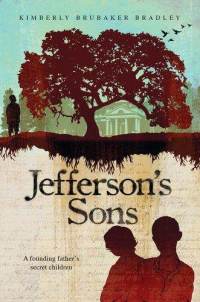
Book Review: Jeffersons Sons: A Founding Father's Secret Children, by Kimberly Brubaker Bradley (Dial Books for Young Readers, 2011)

Recommended for ages 10 and up.

I've had this book on my radar for a while, and had been waiting patiently for one of my many local libraries to purchase it so I could check it out.  My patience finally ran out, and I decided to buy it myself.  Frankly, this is such an important story that I think it's a must buy for school and public libraries and am disappointed that it seems to have escaped the notice of so many of the public libraries near me.  The book has been getting some Newbery buzz from the blogosphere (which probably doesn't mean much, given recent Newbery history!), but it would also be a great candidate for the Scott O'Dell Award for Historical Fiction or the Coretta Scott King Award as well.

I get tired of our founding fathers being treated like saints, particularly in literature for young people--they were far from it, being not only men of flesh and blood but creatures of their time.  In this compelling novel, Bradley tells the story of slave Sally Hemings' children, widely considered to be fathered by Thomas Jefferson (although some controversy persists despite DNA evidence showing that the Hemmings descendants share common traits with Jeffersons' descendants).  The story is told from the point of view of three of Jefferson's slaves--two of whom, Beverly and Madison, were his sons from Sally Hemings, and the third, Peter, the young son of another slave on the plantation who was close to Hemings' children.

Although a slave, Sally Hemings herself was three-quarters white, and a half-sister to Jefferson's wife, Martha (who is already deceased at the time this book takes place).  Her four children who survive infancy--Beverly, Harriet, Madison, and Eston--know who their father is but are forbidden to talk about it.  Their special status means they get special treatment--better clothes, better food, easier work, and even learning to read and write and getting violin lessons, and their mother tells them they'll be freed when they're 21 years old, when they will be able to live as white people.   Although they're 7/8 white, and all but one of them can easily "pass," make no mistake, they are still slaves.  When a captured slave is returned to Monticello and whipped publicly for his crime, Sally and her children are forced to watch along with all the other slaves.

As Jefferson gets older, even those in the slave quarters suspect that his extravagant entertaining at Monticello, his constant building projects, and his love for fine French wines and luxurious goods are leading to greater and greater indebtedness.  What will happen when Master Jefferson dies, and these debts have to be settled?  The precious words of the Declaration of Independence--and its enshrinement of freedom for all--a copy of which is displayed at Monticello, are surely not meant for everyone, when slaves are another form of property and can be sold away at any time.  This story ends with Jefferson's death, and a heart-wrenching slave auction in which families we have come to know in this novel are torn apart.  The novel ends with a four-letter word.  Sold.


An afterword by the author explains what in the book is based on historical fact, and what is made up.  She also explains what is known of Sally Hemings' children.  Her two daughters apparently married white men, never telling about their past, and their families are lost in history.  Madison and Eston Hemings stayed in Virginia until their mother's death, later moving to Ohio and Wisconsin.

While many of the details of Bradley's story are invented, she is careful to make the story historically possible.  She writes in her afterword, "I have done what I can with what we know now.  I've told all the truth I can find; so far as I know, nowhere have I written anything that couldn't be true--that contradicts something we know for sure."  As far as I'm concerned, she's done an outstanding job writing historical fiction populated with real characters, some of whom have left little behind in the historical record.

We owe Bradley our respect for daring to dig behind the "great man" mythology of Jefferson to share with younger readers a broader perspective on not only his life, but how the institution of slavery impacted one of our most important founding fathers and his legacy.

Highly recommended!

Young people who would like to learn more about what happened to Thomas Jefferson and Sally Hemings' offspring might want to read:  Jefferson's Children: The Story of One American Family, by Shannon Lanier (Random House, 2002), a descendant on the Hemings' side of the family.

Wednesday, November 30, 2011

Book Review: Soldier Bear, by Bib Dumon Tak (Eerdmans Books, 2011)

Recommended for ages 8-12.

In this charming novel for children, Dutch author Bibi Dumon Tak fictionalizes the true story of an orphaned Syrian brown bear cub who's adopted by a group of Polish soldiers during World War II, eventually becoming the unit's beloved mascot.  The mischievous bear cub was named Voytek (smiling warrior) by the soldiers.  As the soldiers journeyed through Iran and Iraq on their way to their assignment in Palestine to join their Brtish allies, even the officers softened at the adorable teddy bear of a cub.  But of course, cute little cubs soon grow big, and Voytek soon is getting into plenty of trouble, especially with the resident monkey, Kaska, who loved to throw stones, sand, or whatever she could find at poor Voytek's head.  But that wasn't the whole menagerie that followed the soldiers around; there was also a dog named Stalin, who Kaska liked to hitch rides on, and a dalmatian who loved to romp around with the bear.

Tak writes about the soldiers and their animal friends with such good humor that I found myself laughing out loud at their antics, especially touching in the middle of a war.  When the soldiers are sent to supply Allied troops in Italy, Voytek takes his place helping to move live artillery shells, when he's not stealing food from the cook or sliding up and down cranes like an acrobat, stopping traffic as soldiers stopped to cheer him on.

While a story of a tamed bear who's goodnaturedly given chocolate, beer, and cigarettes isn't quite "politically correct" for today's American audience, I was charmed by the story of Voytek, his animal friends, and the soldiers who loved them in the middle of wartime.  The book is greatly enriched by the pencil drawings of Dutch illustrator Philip Hopman, which perfectly capture the humor and pathos of the story.  Any animal lover will be delighted by the story of lonely soldiers, little more than boys themselves, cuddling up at night with a furry bear, who liked to suck on their fingers at night as a sort of human pacifier.

The conclusion of the book includes some photographs of Voytek with his soldier buddies, as well as an afterword about Voytek's true story.

For more on Voytek and his soldier friends, see this website set up by the son of one of the soldiers from Voytek's unit.  The website offers plenty of photos of the real bear as well, including this one:

Monday, November 28, 2011

Nonfiction Monday Book Review: Alicia Alonso Prima Ballerina, by Carmen T. Bernier-Grand (Marshall Cavendish, 2011)

Recommended for ages 8-12.  

Alicia Alonso is one of the most famous ballerinas of the 20th century.   This new picture book biography by award-winning author/poet Carmen T. Bernier-Grand tells the story of her life in free verse, complemented by the graceful tropical colored illustrations by award-winning illustrator Raul Colon.  Gifted as a child, Alicia dances her first solo at age eleven, and even though her feet, legs, and arms hurt, "ballet dancing/tastes better/than chocolate ice cream."  At the tender age of fifteen, she left Cuba with dancer Fernando Alonso to study in New York, where she marries Fernando and has a baby, leaving childhood and Cuba behind.  But when she and her husband get jobs with Ballet Caravan, her daughter can't go with, and is sent to live with her grandparents in Cuba.  Her career is almost finished when her retinas become detached, and she loses her side vision.  Doctors tell her that her dance career is over.  But Alicia is determined to dance again, and soon she is "America's finest Giselle," flying through the air in Colon's exquisite two-page spread.

Returning to Cuba, she forms Ballet Alicia Alonso, soon renamed Ballet de Cuba.  But politics interfere with her plans, and she refuses to dance in Cuba under the Battista regime.  When Fidel Castro leads a successful revolution in Cuba, Alonso returns there, and dances all over the world, but is exiled from the United States.  Despite the controversy, she was finally invited to dance in the U.S. again in 1975.  The story concludes b showing us Alonso still alive at 90, although no longer performing.

The book includes extensive back matter:  the author includes a detailed biography in an afterword, which provides further details about some of the incidents outlined in the free verse of the main part of the book.  She also lists some of the ballets danced by Alonso, some of her awards and recognition, as well as a list of some of the ballets which she has choreographed.  There is also a glossary, a list of sources, websites about Alonso, and notes and references. 
Alicia Alonso in 1955

This book is likely to be of most interest to aspiring ballerinas and other children interested in dance and ballet.  With the material in the back of the book, this 64 page volume provides enough material for a biographical report for school use.

Tuesday, November 22, 2011

Book Review: The Last Musketeer, by Stuart Gibbs (Harper Collins, 2011)

Recommended for ages 8-12.

As a Three Musketeers fan since I was twelve years old, I was of course excited to read this new time travel story, in which a 21st century boy travels back to France of the early 17th century, befriending the future musketeers, Athos, Porthos, and Aramis.  Author Stuart Gibbs' fast paced, action-packed tale may well appeal to today's tweens, but I couldn't help but be disappointed in the way he interprets Dumas' classic story for the 21st century.

The story starts off strong, with a terrific first sentence that will grab any young reader:  "Clinging to the prison wall, Greg Rich realized how much he hated time travel."  On a trip to Paris with his family to sell the family's treasured heirlooms to the Louvre, Greg and his parents are pulled through a time warp, winding up in 1615.  When his parents are falsely imprisoned for trying to kill the young Louis XIII, Greg must rescue them--by meeting up with three teenagers like himself, Aramis, a young cleric, Athos, a soldier from the lower social classes, and Porthos, a foppish rich young nobleman who's the life of the party.  Greg himself becomes known as D'Artagnan (in the original a fish-out-of-water himself, as a bumbling, hot-headed young man from the distant province of Gascony.  Mix in a nefarious brother of Cardinal Richelieu (the Cardinal being a central character in Dumas' novel), and a young Milady de Winter (the original villainess in the Three Musketeers), some tropes of fantasy fiction (a stone that grants eternal life), and voila!  a 21st century musketeer rehash.


Gibbs does a good job with the whole fish-out-of-water time travel tropes, with Greg disgusted by the smells of Paris, the privies, and the fleas, among others.  The book of matches in his pocket make the 17th century characters he meet think he's a magician, as does his ability to swim.  There's plenty of action, as Greg and his new-found friends swashbuckle their way to saving Greg's parents.  At the end, they don't go back to the 21st century, which makes me think that Gibbs has a sequel up his sleeve.

While I can't help but appreciate any author that brings Dumas' characters to the attention of 21st century kids, I couldn't get over several changes to the original story that drove me crazy.  First of all, the author keeps referring to Greg being in medieval Paris.  While the streets of Paris might have been similar to the way they were in the Middle Ages, 1615 is definitely not considered the Middle Ages, and I wonder how such a glaring error could have escaped the Harper editors, not to mention the professor of French history who Gibbs thanks in his acknowledgment for vetting the manuscript.  Second, and what bothered me more as a fan of the original novel, which I couldn't help wondering if Gibbs had actually read, he changed many key elements of the musketeers' personalities.  For example, Athos, or the Conte de la Fere in the original, was a member of the nobility, not a common soldier, as Gibbs makes him out to be.  Appearing as a young girl, the character of Milady de Winter doesn't make sense with that name, since she is supposed to have married an English lord after having been married to Athos as a young girl.  Also, it's not very believable that 14-year old boys would be made guards of the king!  Any young person who reads this and goes on to read the original Dumas is going to discoverer the many inconsistencies, which I just don't think were necessary.   And by turning the somewhat ordinary Greg into D'Artagnan, Gibbs eliminated one of the funniest and most memorable characters in the book, the young Gascon around whom the plot unfolds.

In short, while I enjoyed the concept of this story, I believe the execution could have been much better, simply by keeping more to the original outlines of Dumas' immortal characters.  Unfortunately, I don't think that Gibbs' changes to the basic characters really added to the story, but rather detracted from it.  It will be interesting to see if a sequel is in the making.


Has anyone seen the new 3-d Musketeer movie?  I haven't yet, discouraged by the terrible reviews!  My favorite film version is still the Richard Lester version with Michael York, Richard Chamberlain, Faye Dunaway, and others from 1973. Although this version made changes from the original, it was very much in the sprit of the original novel.