Monday, July 1, 2013

Nonfiction Monday Book Review: Nelson Mandela, by Kadir Nelson (Katherine Tegen Books, 2013)

Recommended for all ages

With Mandela apparently on his deathbed, it's an appropriate time to take a look at this moving new picture book biography of the iconic South African figure by celebrated African-American author/illustrator Kadir Nelson. Nelson's magnificent paintings complement the poetic text, which begins by evoking Mandela's bucolic boyhood in the South African bush. At the tender age of 9, he was sent away to continue his schooling, the only one in his family to be chosen for Western formal schooling. His intellect was apparent even at an early age, and we see Nelson (a name given to him by British teachers) growing into a fine young man, a lawyer for those who couldn't defend themselves. Kadir Nelson describes the cruel policies of apartheid in simple terms suitable to a young audience, in a lyrical text that resembles free verse. The outlines of Mandela's life are all here--Mandela protesting with his fist raised in the air, Mandela tried and imprisoned, his people fighting for his release over the long years of jail, his triumphant return and election to president. But as usual with Kadir Nelson's work, it is the illustrations which overwhelm us with their quiet power. Highly recommended for adults as well as children.


For more on Mandela for young people, check out his own picture book autobiography, Nelson Mandela:  Long Walk to Freedom (Flash Point, 2009).  For older children and adults, I would also recommend the abridged version of Mandela's own autobiography, Mandela:  An Illustrated Autobiography (Little Brown, 1996), a fascinating and accessible version of his much longer autobiography published in 1994.  


Wednesday, June 26, 2013

Book Review: Paris-Chien: Adventures of an Ex-Pat Dog, by Jackie Clark Mancuso (La Librairie Parisienne, 2013)

Recommended for ages 4 and up.

Picture books about dogs are a dime a dozen, but picture books about dogs in Paris--ooh, la, la, that's a smaller group.  I remember on my first trip to Paris, many many years ago, being flabbergasted that dogs were everywhere--including in restaurants, where they were treated with great respect.  But what would it be like to be an American dog in Paris?

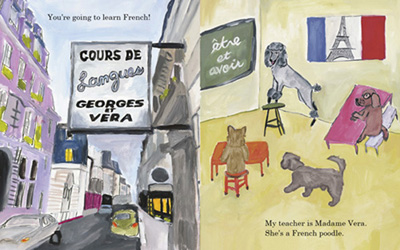
In Paris-Chien (a pun on the French word parisien--OK, it took me a few minutes to get that one, and you have to pronounce Paris in French--par-ee--for it to work!), we meet Hudson, an adorable Norwich terrier who has recently moved to Paris with his American owner.  However, adjusting to a new culture is apparently as difficult for dogs as for people--Hudson didn't realize that French dogs spoke French rather than "dog"!  But no worries, his owner enrolls him in French language classes, taught by Madame Vera--a French poodle.  Soon Hudson is as happy as a clam--or maybe a baguette or croissant--in his new home, and even has a French girlfriend!


This is a delightful book that is sure to please dog lovers and Francophiles alike.  The book is peppered with French phrases, which are translated in a "petit dictionnaire" in the back (although there is no phonetic translation, so the author seems to assume that the readers will already know a little French).  Children and adults alike will enjoy the "fish out of water" story of Hudson adjusting to Paris, told with a gentle sense of humor.  The gouache artwork is particularly charming, and the color palette and flat, stylized technique evoke 20th century French artists such as Matisse.

Author Jackie Clark Mancuso was inspired to write this book by her own experiences as an ex-pat in Paris.  Hudson is a real dog, and you can learn more about him on his Facebook page.


Monday, June 10, 2013

Nonfiction Monday Book Review: Becoming Babe Ruth, by Matt Tavares (Candlewick, 2013)

Recommended for ages 5 and up.

I am not much of a sports fan, but I do enjoy books about baseball players of long ago.  Babe Ruth is such an epic figure in the history of sports, but one that I suspect kids today do not know that well.  When I was growing up, I remember well when Hank Aaron broke Babe Ruth's lifetime home run record, which was a huge deal back in 1974.  Of course since then, the record has been broken again by the controversial Barry Bonds, and now Ruth ranks 3rd on the home run king list.  But given the much shorter seasons played in those days, being third doesn't really diminish Ruth's stature as one of the great home run kings!

Matt Tavares has written some wonderful baseball picture books, including Hank Aaron's Dream and There Goes Ted Williams.

Tavares' new picture book on Ruth is a wonderful addition to these prior books.  It concentrates on Ruth's early years, when he was just a kid in Baltimore who got into trouble a lot.  At the tender age of seven, he was left by his parents at a very strict reform school, St. Mary's Industrial School for Boys.  Although to contemporary kids this must seem like a fate worse than death, it's not so bad for George, because he gets to play baseball almost every day.  At school, he's taken under the wing of Brother Matthias, an excellent baseball player himself.  While still at St. Mary's, George is signed by the minor league Baltimore Orioles.  His teammates nickname him "Babe" since he is only sixteen and amazed by everything outside the gate of St. Mary's!  Starting out as a pitcher, Ruth is quickly traded to the major leagues, where he becomes a star pitcher for the Red Sox--at least until 1920, when he is sold to the Yankees for the huge sum of $125,000--the biggest fee ever paid at that time for a baseball player!

But Tavares shows us another side of Ruth--his compassion for orphans and kids from the wrong side of the tracks.  When his boyhood home, St. Mary's is destroyed by fire, Ruth invites the school band to tour with the Yankees to raise money to rebuild the school.  He even invites them to ride the train with him and treats them to ice cream sundaes in the dining car!

Tavares' oversized illustrations capture the jumbo personality of Babe Ruth, who became the biggest celebrity in America.  Tavares writes  "He wears fancy clothes, custom tailored just for him. He drives fast cars and throws wild parties.  He eats enormous amounts of food.  He does whatever he wants.  And he clobbers the baseball like nobody ever has."

Back matter includes an author's note with additional biographical information on Ruth, as well as his pitching and hitting stats and a brief bibliography.  Highly recommended!

Monday, June 3, 2013

Blog Tour and Giveaway: In Search of Goliathus Hercules, by Jennifer Angus


I am delighted to be a stop on the blog tour for author Jennifer Angus, debut author of a delightful and innovative historical fantasy for middle grade readers, In Search of Goliathus Hercules. Set in 1890, this novel features an appealing young hero, ten-year old Henri, who discovers an incredible talent--he can communicate with insects!  This ability allows him to train an amazing flea circus and communicate with ordinary houseflies and butterflies.  But there is more afoot--with shades of Kafka, Henri discovers he is becoming more insect-like by the day!  And can he solve the mystery of his father's disappearance into a far-off jungle, never to be heard from again?

Her novel definitely channels the wry humor of British authors Roald Dahl and Eva Ibbotson and features the most charming insect characters I have encountered since James and the Giant Peach.  It's a real treat to read, with a quirky sense of humor and many endearing characters.  

In this guest post, I asked her if she would reflect on her lifetime interest in insects.
 Insects and Childhood

Jennifer Angus
Perhaps you have walked on a warm summer evening and seen fireflies dancing in the sky. There is something magical about the sight. I’ve often wished I could be part of the festivities and the mystery.  That desire might seem childish which brings up an observation that children’s literature is populated with wonderful six legged characters such as the insect companions in James and the Giant Peach or the fabulously glamorous cockroach in La Cuchuracha Martina. I was interested to discover that what is considered the first children’s story in the English language which was not a moral tale or fable is The Butterflies Ball and The Grasshoppers Feast by William Roscoe dating from 1808. In the Victorian era, both adults and children were introduced to the natural world through a large number of educational publications in which insects were anthropomorphized so as to have greater appeal to the general reading public. Voracious collecting of all manner of plant and wildlife was extremely popular at that time.

Through second to fifth grade my family lived in Niagara Falls, Canada. On a rainy Saturday or Sunday my parents would give my brother and me money to go to a museum. Our favorites were the Ripley’s Believe It or Not, the Houdini Wax Museum and the Niagara Falls Museum. The latter was an old Victorian style museum that was old, musty and near the end not even heated. On the top floor were the animal “oddities” – things like the 2-headed dog or the five-legged calf. On that floor I remember seeing insect collections that were put into words and patterns. These early experiences have very much informed both my art exhibitions and my writing.


I am best known for my “insect wallpapers” but as my thinking as progressed I have made my own cabinets of curiosity in which Victorian poems are etched on to the backs of metallic beetles, and shadow boxes containing insect samplers that spell out nursery rhymes.  For my exhibition “Insecta Fantasia” at the Newark Museum I created dioramas in which insects appear to enact scenes from famous fairytales such as Sleeping Beauty and Hansel and Gretel.

Typically a diorama creates a realistic scene however in mine the insects inhabited a monochromatic brown world of beeswax. The subdued landscape is both surreal and provocative. The dioramas inspired further works in which vintage style dollhouses were covered in wax along with the furniture too. Again insects appear to live and carry out activities in these spaces. The houses with their 6-legged occupants are reminiscent of the work of Walter Potter (1835-1918), the celebrated taxidermist whose Kitten Wedding included 20 felines taxidermied and dressed for the occasion. The Rabbit School saw 48 bunnies posed at desks and studiously note taking upon slates. 


Likewise in children’s literature animals are often anthropomorphized so that the reader can relate thus giving both insight and empathy. Author Beatrix Potter turned the tables so that despite the fact that Peter Rabbit naughtily gorged himself on Farmer McGregor’s crops the reader cheers for Peter rather than the aggrieved farmer. In the “Tale of Two Bad Mice,” the aforementioned rodents create mayhem and destruction in a dollhouse yet all is forgiven when they offer restitution of sixpence and a daily cleaning service.

Similarly I seek to rehabilitate the image of insects through my artwork and “In Search of Goliathus Hercules”.


Giveaway:  Albert Whitman & Co. has kindly made available a give-away for The Fourth Musketeer blog readers.  If you would like to win a copy of this unique novel, please leave a comment below with your e-mail address!  The winner will be chosen by June 15th through a random number generator.  

This title is available in e-book at the following:  www.openroadmedia.com.  It can also be ordered directly from the publisher, Albert Whitman & Co.  

The next stop on Jennifer's blog tour is at A Patchwork of Books tomorrow!


Wednesday, May 29, 2013

Book Review: Jepp, Who Defied the Stars, by Katherine Marsh (Hyperion, 2012)

Recommended for ages 10 and up.

I'm fascinated by the character of Tyrion Lannister, the cunning dwarf in Game of Thrones.  You don't find a lot of literature with a dwarf as one of the heroes (or perhaps in Tyrion's case, an anti-hero).  Perhaps my interest in Tyrion is why I picked up this book by Katherine Marsh about a teen-aged dwarf in 16th century Europe, but Jepp's story quickly engaged me on its own terms.  

Jepp is living a relatively happy and protected life at his mother's inn in the countryside, until a wealthy courtier appears and invites him to a life of luxury Coudenberg Palace, the home of the Spanish Infanta.  There he joins a small group of court dwarves, and Jepp is shocked when he realizes that he is to be a pampered pet, fed morsels at the dinner table and popping out of pies.  Jepp plots a daring escape for himself and his dwarf friend, Lia, but is soon recaptured and sent away to another court, that of a Danish nobleman, Tycho Brahe.  His new master is fascinated by the science of the stars, including astrology.  Despite his dwarf size, Jepp is no fool, and would like to be part of the learned world of the scholars.  Can Jepp change his own destiny or is he fated to always be controlled by others?  How will he find his way in what often is a cruel world?

The author states that she was inspired to write this novel through her fascination with the famous paintings of court dwarfs by Spanish painter Diego Velasquez.  As she explains in an author's note, Jepp was an actual dwarf who served as court jester at the court of Tycho Brahe, but very little is known about him.  Although his story is largely invented, the life of court dwarfs was carefully researched by the author and seems to be accurately portrayed.  Marsh was also inspired by her mother's passion for astrology, which plays a central role in this story.

Las Meninas, by Velasquez

If you're tired of dystopian and fantasy YA novels, I highly recommend this book! Marsh's book was honored as a New York Times Notable Children's Book of 2012 and also by The Wall Street Journal's Best Children's Books of 2012.  It definitely stands out among the crowd of books that all seem to look the same these days.  Even the handsome cover and design of this book are unique, with the end papers decorated with a beautiful astronomical chart that depicts, instead of constellations, various elements of the story.   It's a unique coming of age story, with a beautifully rendered and written story, which transports us to another time and place in the way which good historical fiction can do just as well as fantasy.  Being a YA novel, there's even a bit of romance involved.

In addition to the above-mentioned Author's Note, back matter includes an interview with the author.


Wednesday, May 22, 2013

Book Review: Lauren Yanofsky Hates the Holocaust, by Leanne Lieberman ((Orca, 2013)

Recommended for ages 12 and up.

"Some kids got Disney.  I got Hitler."  No way could I NOT read this book after reading that line on the back cover--and the title intrigued me as well.

The novel's protagonist, Lauren, doesn't want to be Jewish any more.  It's not that she wants to be a different religion--she just wants to be a "non-Jew by choice."  She grew up going to Jewish day school; her father's a Holocaust historian.  At her house, she quips, every day was Holocaust Remembrance Day.  Family vacations (instead of going to Disney World like other people) revolved around trips to Holocaust memorials. "Why would anyone want to belong to a religion that was all about loss, grief, and persecution?" she muses.

Lauren manages to convince her parents to send her to the public high school.  But even there--where incidentally they have a much better basketball team for Lauren to play on--she can't escape the legacy of the Holocaust, however much she might try.  When she sees some of her friends--including Jesse, a boy she likes--playing Nazi war games, she is confronted with a dilemma.  Should she betray her friends, and risk being a social pariah at school, or betray her heritage, by remaining silent?

While in many ways this is a "typical" teen novel with boyfriend and friendship drama, Lauren's struggle with her heritage is described in an entertaining and also thought-provoking way that make the novel highly readable for teens.  Jewish young people are likely to be particularly attracted to this novel, particularly because of the intriguing title!


Tuesday, May 21, 2013

Book Review: Enemy Territory, by Sharon E. McKay (Annick Press, 2012)

Recommended for ages 9-14.

Given the complexity of the topic, it's perhaps not surprising that there's not a plethora of novels for young people on the Israeli-Palistinian conflict.  It's a topic that ignites fires of passion on both sides, and what a challenge for a novelist to try to present a balanced point of view in a book for young people.

I was very impressed with Sharon McKay's take on this topic.  She presents us with two teenaged boys, one Jewish Israeli and one Palestinian, who are thrown together as roommates in a Hadassah hospital in Jerusalem.  Both have suffered grievous injuries; Sam, our Israeli teen, has a seriously injured leg and may face amputation, and Yusef, our Palestinian, has lost an eye and may lose his other eye as well.  Both have their own extreme prejudices, indeed, we could say hatred, of the other side.  But when they decide to escape from the hospital to go on an innocent errand--a trip to a famous candy shop in Old Jerusalem, they get lost and are quickly in more trouble--and danger--than they could have imagined.  Can they work together to find their way back?

McKay does an admirable job of using Yusef and Sam as spokespeople for each side of the conflict, and we see through these two boys the misperceptions and fear each side has of the other. Their frustration with the other's point of view even makes them come to blows at one point in the novel.  McKay takes no particular point of view, but tries to show the commonalities between the two groups as well as the differences.  While the "happy" ending may be a bit pat, I would recommend this novel to young people who want to get a better understanding of the emotions behind the long-ranging Middle East conflict.  Back matter includes notes which define certain terms which are used in the novel.  

This novel has received numerous awards, including the 2013 Helen and Stan Vine Canadian Jewish Book Award.