Friday, February 25, 2011

African-American History Month Book Review: Bird in a Box, by Andrea Davis Pinkney (Little Brown, 2011)

Release date:  April 12, 2011


Recommended for ages 8-12.  


Set in 1936, at the height of the Great Depression, Bird in the Box is described by the author as "mostly a book about the power of the human spirit, and of how one man's triumph brought glory to so many people."  This moving novel weaves together the story of three different children in Elmira, New York: the sassy Hibernia, the daughter of a reverend, whose mama ran away to New York City right after she was born with dreams of being a jazz singer; Willie, who lives with his abusive, drunk father and his suffering mama while he dreams of being a boxer like his idol Joe Louis; and Otis, an orphan whose parents were killed in a tragic accident, and who keeps their memories alive by remembering his father's riddle-jokes.  All three children idolize Joe Lewis, the Brown Bomber.  As Otis' ma tells him,
"When Joe Louis fights, it's more than just throwing punches, Otis.  That boy's fighting for the pride of Negroes.  When he loses, every colored man loses a little piece of his own pride."
Andrea Pinkney captures the unique voice of each of the three narrators, whose lives converge at the Mercy home for Negro Orphans, where Willie's mother sends him to escape the abuse of his violent fathers.  At Mercy, he becomes friends with Otis, as the two bond over Otis' Philco radio.  Hibernia meets the boys while singing with the church choir at a special holiday performance for the orphans.  A stray cat the boys name Bird joins their ersatz family, and before you know it, they're all gathered by the radio listening to Joe Louis' championship fight. By using actual transcripts from radio broadcasts of Joe Louis' boxing matches, Pinkney provides an immediacy to her descriptions, as we can feel the excitement of the children listening to the matches on the radio.

This book is filled with appealing characters, from the three children to the supporting cast, from the strict Reverend to the kind Lila, who works at the orphanage.  Pinkney skillfully weaves in historical information about Joe Louis, a key figure in African-American history, and as Pinkney describes him in her author's note, "a strong and beautiful symbol of hope."  The author's note includes biographical information on Joe Louis, as well as information on her great-grandfather, an amateur boxer in Elmira, New York, who was the model for the character of Willie in this novel.

For more on Joe Louis for young people, see the following:

Matt de la Pena and Kadir Nelson.  A Nation's Hope:  The Story of Boxing Legend Joe Louis (Dial, 2011)
George Sullivan.  Knockout:  A Photobiography of Boxer Joe Louis (National Geographic, 2008)
William Miller and Rodney Pate.  Joe Louis:  My Champion (Lee & Low, 2009)

Wednesday, February 23, 2011

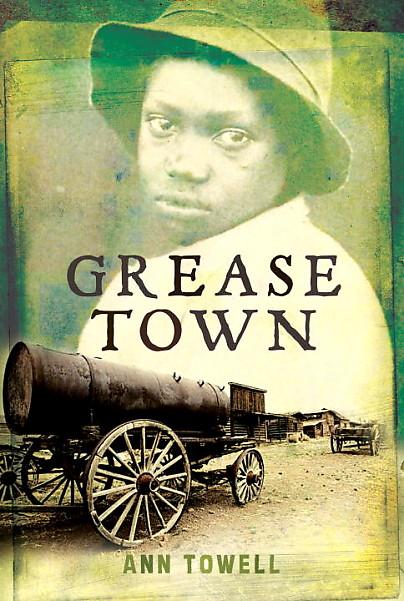
African-American History Month Book Review: Grease Town, by Ann Towell (Tundra Books, 2010)

Recommended for ages 10 and up.


Curious about what happened to the slaves who ran away to seek freedom in Canada?  Unfortunately, not everything went smoothly for all the runaways who made it to Canada.  In this historical fiction novel for young people, author Ann Towell spins a tale based on a real race riot that took place in 1863.

The story is narrated by Titus, a 12-year old boy who stows away in his older brother's wagon to the Canadian oil fields in Oil Springs, Ontario, around the time of the Civil War.  Titus has been living with his Aunt Sadie and her husband, and he's had just about enough of his aunt's nagging.  When his brother Lemuel plans to leave to go to his Uncle Amos' house at the oil fields, Titus figures it's time for him to have some adventures rather than go to school.  On the road to the oil fields, they meet up with a stranger, John, whom Titus figures is bad news.  "There didn't seem much about him that was honest and true," Titus tells the reader.

With the cover image of a young black boy, I was convinced at first that the narrator, Titus, was black himself.  It took me quite a few pages to figure out that the character we see on the cover is in fact not the narrator, Titus, but rather Moses, a young black boy that Titus befriends when he arrives at Oil Springs.  Moses is the first Negro Titus has ever seen, and he describes his face as a "dark color like the beautiful walnut sideboard Aunt Sadie had in the dining room."  Moses and Titus even start a business together, giving tours of the oil fields to curious folk from the cities.

But the former slaves didn't leave all their troubles behind--some of the oilmen are trying to wreak havoc about the black people working on the oil wells, stirring up trouble by telling people that the blacks are taking jobs away from them by working for less pay.  When their tactics don't work, they stoop even lower to rile up the crowds and drive the blacks out of town.  Titus winds up an eyewitness to the violence.  Can Titus save his friend Moses and his family and help bring the troublemakers to justice?

We learn so little in school about our neighbors to the north that I am always glad to discover a historical novel that explores Canadian history, particularly as it intersects with our own past.  Clearly racism didn't end at the Canadian border, despite the lack of a history of slavery in Canada.  This novel offers an interesting perspective on the Civil War period from the other side of the border, and it's also a moving coming-of-age story about a young man who's forced to confront his fears in order to pursue what's right. 


Other blog reviews include:  Ms. Yingling Reads,
Quill and Quire, Good Books and Good Wine, Bookish Blather, The Magic Lasso, Journey of a Bookseller. 

Monday, February 21, 2011

African American History Month Book Review: Play, Louis, Play: The True Story of a Boy and His Horn, by Muriel Harris Weinstein (Bloomsbury, 2010)

Recommended for ages 7-10

This new biography of jazz great Louis Armstrong tells the story of his childhood from the perspective of his first trumpet, bought from a run-down pawn shop in New Orleans.  This unusual narrator provides a distinctly different point of view in this engaging biography for young children.

Author Weinstein describes Armstrong's very poor childhood in the toughest neighborhood in New Orleans (known as The Battlefield), but notes that Louis never complained; "he said [complaints] hurt his ears as much as a horn's sour notes."  Despite his poverty, Louis had the ability to look on the bright side of life.  From an early age, Louis was known for his huge smile, which everyone said was as wide as an open satchel.  So they called him "Satchelmouth," eventually shortened to Satchmo.

We see Louis introduced to jazz, so fascinated by the pulsing rhythms that he would sneak into clubs and hide under tables to listen to the music.  Although it was clear from an early age that Armstrong had a great gift for music, with his family's poverty, there was no money for an instrument or music lessons.  But when he was about seven, he went to work in the junk business of the Karnofskys, a Russian Jewish family who lived on the edge of the black neighborhood.  The Karnofskys fed Louis, gave him work, and in honor of their kindness, he wore a Star of David necklace his entire life.   According to this book, the Karnofskys loaned Louis money to buy his first cornet, our narrator, the five dollar horn in the pawn shop.

With the need to make money, there was little time for Louis to go to school, and he dropped out in the 5th grade to take up singing with a quartet of boys on a street corner. But when he was 12 years old, Louis was arrested for firing a gun in the air on New Year's Eve, and sent to the Colored Waif's Home for Boys, out in the countryside, a combination orphanage and reform school.  There he had the opportunity to study music and even play in a band, and had clean clothes and three meals a day.  He spent a year and a half there, and when he left, he worked shoveling coal during the day and singing in a quartet and playing cornet after that.  Before long he was discovered and earning a dollar a night to play in a band with King Oliver, who took Armstrong with him later to Chicago.

This book ends as Armstrong is becoming successful and famous, and doesn't deal at all with the later part of his life.  However, an Afterword describes how he was considered the greatest cornet player in the world, and later the greatest trumpet player.  The author describes what made Armstrong special, including his skill at improvisation and his scat singing.  She also points out that despite his lack of formal schooling, Armstrong enjoyed writing and kept journals as well as writing two autobiographies.  The book also includes a glossary of jazz terms and jazz slang, as well as a brief bibliography.

This is an entertaining and interesting book for young readers, although it doesn't strive to give a complete picture of his life, concentrating instead on his colorful childhood in New Orleans.  It also doesn't delve into the more controversial parts of Armstrong's biography, such as his reputation among some in the black community as an "Uncle Tom," or his initial lack of public support for the civil rights movement.

For more on Armstrong, check out the website for his home in New York, now a museum, which offers a complete discography and bibliography on the artist.

An interview with the author about this book can be found at the blog Author Amok.

For other books on the topic, explore some of the following titles:

Weinstein, Muriel.  When Louis Armstrong Taught Me Scat (Chronicle, 2008).  A picture book about Armstrong's unique skat style.

McDonough, Yona Z.  Who was Louis Armstrong?  (Grosset & Dunlap, 2004).  Part of a series of biographies well-suited to middle grades.

Jenkins, Leonard.  If Only I Had a Horn (Sandpiper, 2002).  Another book concentrating on Satchmo's childhood.

Friday, February 18, 2011

African-American History Month Book Review: The Beautitudes: From Slavery to Civil Rights, by Carole Boston Weatherford, illustrated by Tim Ludwig (Eerdmans Books for Young Readers, 2010)

Recommended for ages 8 through adult.


This inspiring picture book for all ages uses the Beatitudes--the famous lines that begin Jesus' Sermon on the Mount--as the background for a trip through African-American history, particularly as faith has influenced the quest for freedom and equal rights through different eras.  Award-winning author Carole Boston Weatherford uses free verse text to describe God's omnipresent role throughout the long struggle, beginning with the voyage on slave ships to America and ending with Barack Obama taking the presidential oath.

Here's an example of her moving verse:

I was with the U.S. Colored Troops
who fought to end slavery during the Civil War.
I beat the drum for freedom.

I was with Booker T. Washington
and Mary McLeod Bethune, who built colleges
and lit the way for young minds.
I was the lamp.

Carole Boston Weatherford's text is enhanced by stirring watercolor and pastel illustrations by Tim Ladwig, who is both an artist and minister and has illustrated other picture books with biblical texts.  In The Beatitudes, he depicts both famous individuals and ordinary African-Americans with the same dignity, and many of the illustrations are infused with a beautiful golden light.   At the conclusion of the book are brief biographical profiles of the famous African-Americans mentioned in the text, including Ruby Bridges, Rosa Parks, Martin Luther King, Emmett Till, Marian Anderson, Harriet Tubman, and Barack Obama.

This is a beautiful volume for any home or public library, and can be enjoyed by readers of any race or religious faith.

Wednesday, February 16, 2011

African-American History Month Book Review: Ben and the Emancipation Proclamation, by Pat Sherman, illustrated by Floyd Cooper (Eerdmans Books for Young Readers, 2010)

Recommended for ages 8-12.


This stunning picture book for older readers is a great choice to read aloud in class for African-American history month.  Based on the true story of a young slave, Benjamin Holmes, who, despite the odds and the fact that it was against the law, had learned to read.  Ben had learned the alphabet from his father, and when Ben was apprenticed by his master to a tailor in Charleston, he discovers plenty of secret ways to figure out words, whether in the ledger, on boxes in the shop, or in store windows in Charleston.  He even picks up copies of discarded newspapers to teach himself, learning to read about abolition and freedom.  And, encouraged by his mother on a rare trip home to the plantation, Ben teaches himself to write as well.

Although he hid his reading and writing from the whites, it was harder to keep his skills secret from the other slaves.  When war breaks out, Ben is sent to a slave prison, to stay there until sold, where he decides he'd just forget about reading..."it could only lead to trouble."

But one night, the slaves bribe a guard for a copy of the Charleston newspaper, and beg Ben to read it to them.  As Ben begins to read, we read along with him the famous words of Lincoln's Emancipation Declaration:  "All persons held as slaves within any State or designated part of a State, the people whereof shall then be in rebellion against the United States, shall be then, thenceforward, and forever free..."  The author ends the story with Ben peering at the golden light of daybreak through the slats of the shed...wondering what this new freedom would look like.

This book would not be nearly as effective without the handsome illustrations of illustrator Floyd Cooper, using his signature oil on board technique.  His illustrations have an old-fashioned quality that makes use of warm earth tones, reminding the viewer of sepia-toned photographs of the time period.  The two-page spread of Ben reading the Emancipation Declaration is particularly striking in its dramatic simplicity, as Ben is presented in a head and shoulders perspective, reading the newspaper, while the other slaves are seen only in shadow.

An Author's Note with brief biographical information about Benjamin Holmes follows, in which we learn that after the war he attended Fisk University, where he became a member of their Jubilee Singers, touring throughout America and Europe, as well as becoming a teacher.  Additional resources, both books and websites, are also listed.

Tuesday, February 15, 2011

Author Interview: Andrea Alban, author of Anya's War

Andrea Alban
The Fourth Musketeer is pleased to welcome debut novelist Andrea Alban, author of the just released middle grade novel Anya's War.  Andrea, who started her career in marketing and design, is the co-creator of picture books, inspirational books, guided journals, and greeting cards.  She lives in San Francisco with her family. 

Q:  Anya's War, your first published novel, is a real departure for you; the other books you've published, under the name Andrea Alban Gosline (which readers can explore at Andrea's author website) have been delightful picture books done with illustrator Lisa Bossi as well as a line of adorable journals, greeting cards, and other merchandise. Can you tell us a little bit about why you decided to write a novel for young people with a more serious topic and setting?

A:  It’s actually the other way around; the novel began in my head twenty five years ago, having grown up hearing the stories of my father’s childhood in Jewish Shanghai. I left college in my senior year to begin the actual writing, but work, marriage and motherhood sidetracked me. Twenty five years later, I went back to school to finish my creative writing degree, along with this novel. The other publishing ventures – children’s books, inspirational parenting, and merchandising happened somewhat serendipitously. Lisa Bossi and I were asked to write a book on motherhood after meeting with a publisher who saw one of our picture book manuscripts. That book, Celebrating Motherhood, led to numerous inspirational parenting books, and eventually circled back to children’s fiction. Writing a novel, this novel, was always my goal; I was fortunate that the children’s and parenting books had tremendous momentum, and success.

Q:  Anya's War is based on the history of your own father growing up as a Russian Jew in Shanghai; while I knew that Jews escaped the Nazis in Shanghai, I didn't realize that there was a significant Jewish presence there even earlier.  Will you be continuing Anya's story with a sequel describing what happens to her and her family during the war years?

A:  Yes, this book is the first in a planned trilogy that will span the years 1937 – 1949.

Q:  What made you decide to change the main character into a girl instead of using a boy (based on your father) as the protagonist?

A:  In my original draft, the protagonist was Georgi, Anya's little brother, based on my father Yan. As I continued to shape the story, the character of Anya ( based on my father’s older sister, Lily), had such a strong voice. I found Anya's world began to flow more vividly for me. So I decided to focus on Anya's escapades in this book. In the second book of the series, Georgi moves to the forefront, although Anya and the rest of the family remain pivotal to the plot.

Q:  I would love to know more about the historical research you did on Jews in Shanghai during this period?   Were there family members still alive that you were able to interview?   Did you travel there as part of your research?

A:  My research began with the oral histories I jotted down of my father, Aunt Lily, Babushka, and many of their friends who had remained a close-knit group of "Shanghai Jews."  Aunt Lily's best friend, Luba Tuck, shared stories and photos as well. (Luba is Giselle in the novel.) In 1993, I gained access as a scholar to the oral history archives at the Judah Magnes Museum. I also read every memoir published by Jewish authors who had lived in Shanghai during the  WWII years. Although I didn't journey to Shanghai during the writing of the book, I felt as if I had visited. I was fortunate to inherit the entire archive of family photos, correspondence and legal documents, including passports, quarantine statements, and grade school report cards! (My father received above average grades but one of his teachers noted that his comportment must improve! It's ironic but not surprising that I didn't hear that part of the education story when I was still attending school.) After both my Aunt Lily and Uncle Bernie passed away, a truckload of antique furniture, lamps, clothing, Babushka's oil paintings, and Lily's beloved piano traveled from NY to my home in San Francisco. I am surrounded by the memories and aesthetics of 1920s-40s Shanghai. I plan to visit the former French Quarter of Shanghai within the next few years. My hope is to locate my grandfather Isai's tombstone and place a pebble on its top. This Jewish ritual will signify that I have honored his memory with a visit to his grave. His ideals live on and  impress me - just as the pebble made an impression on my hands.

Q:  How did your father's unusual background, with its Chinese and Russian influences, impact your own childhood?

A:  My father's background impacted my childhood on many levels: aesthetically, linguistically, and in a culinary sense. I grew up with Chinese and Russian imagery in the family home including artwork, textiles, and furniture. We have a samovar for serving tea. We regularly ate Chinese food, and every year my Russian grandmother visited for six years, filling our home with the tastes of my ancestral land including borscht, pirogue and piroshki, My father was fluent in four languages which informed my development as a poet along with my love of classical music and opera. The Chinese and Russian cultures have a shared emphasis on family and education. So both these cultures – Chinese and old European – wove together in my home and resulted in a highly ethical child rearing system.

Q:  Andrea, you also blog about motherhood at Calm and Confident Moms.  Can you tell us a little bit about what sort of topics you cover on your blog?

A:  The purpose of my blog is to share my insights into peaceful parenting. It was born out of a wish: to find reassurance and ease when I am struggling, to learn how to accept my mistakes and move forward. This is what I most need as I strive to give my children, and myself, the gift of peace and a happy day. My blog entries explore how we as mothers can create little moments of peace and a welcoming world for our children, how to tackle a big project as we would dressing in the morning: one button at a time, how to manage the moment just as it is because that is our life purpose, and having the humility and grace to drop the need to be right. As our culture becomes increasingly dependent on electronic gadgets and busy with myriad activities, it is my intention to encourage parents to slow down, and encourage a play-centered curriculum which of course includes reading and storytelling.

Q:  Could you share with us a few of the books that are currently on your nightstand (i.e. ones you are in the process of reading?)  Do you read mostly children's, YA or adult titles?

A:  I usually have three books going at once: a novel, an inspirational book, and a nonfiction book, usually historical about whatever era I am currently fascinated by. I just finished Room by Emma Donahue, a brilliantly crafted book told by a believable five year old narrator. I'm on page 65 of The Corrections by Jonathan Franzen. I missed this rich and quirky novel when it first published ten years ago. I am re-reading A New Earth by Eckhart Tolle, finding new inspiration to let go of ego and its illusions on every page. Instead of a history book, I am reading Yoga Journal, specifically an article about mastering the fine art of balance. I enjoy reading most genres but gravitate towards literary adult fiction.


Q:  What authors, particularly of children's books, have been a real inspiration to you?

A:  I learned while studying for my Creative Writing degree to read like a writer. When I read, I love to deconstruct the prose and learn from the masters how to craft snappy dialog, compelling settings, believable and lovable characters. My favorite writers to read and be entertained by are Isabel Allende, Laurie Halse Anderson, and Karen Hesse. I get happily lost in the story worlds and dramatic action that these authors create.


Andrea, thanks so much for visiting me here on The Fourth Musketeer.  We'll look forward to reading the next volume of Anya's story!

Monday, February 14, 2011

Book Review and Giveaway: Anya's War, by Andrea Alban (Feiwel and Friends, 2011)

Recommended for ages 12 and up.  


In her debut novel for young adults, San Francisco writer Andrea Alban mines her own family history to weave a compelling coming-of-age story of a fourteen-year old Russian-Jewish girl and her family in 1937 Shanghai.  Anya and her family had left their comfortable life in Odessa, where Mama was an opera singer and Papa was a journalist, because Papa wouldn't join the Communist Party, and sought safety from the Russian Secret Police in far-off Shanghai, then a safe-haven for many Jews.

The story opens with Anya writing a list of wishes in her diary. Their servant, Li Mei, has told her that planting wishes under a full moon gives them the best chance of coming true.  What does a 14-year old girl in 1937 Shanghai wish for?

She wishes Amelia Earhart, her idol, will be found safe somewhere in the Pacific.  She also struggles with telling her mother the truth about her hopes for the future--going to university in the United States, not becoming an opera singer like her mother.  "I am absolutely, one hundred percent certain that I don't want to sing opera.  I think."  And she's trying to think of something witty to say to a boy she likes at the bowling club, hoping her right bosom will grow extra fast to catch up without her left side, and last but not least, wishing "the Japanese would stop killing Chinese children by accident."

But Anya's life changes when she discovers, on her way home from purchasing the family's food for Sabbath dinner, an abandoned basket with an unwanted newborn girl baby inside.  What should she do?  The baby was thrown away by her family, but Jews don't throw out baby girls, Anya tells herself.  "All girls are precious.  We're all the same." She impulsively decides to take the baby home with her, where she is helped by her best friend, Giselle, and Li Mei.  Will her mother allow her to keep the baby safe?  But Anya soon learns that no place is safe, especially for her new friend Gabriel and his father, who fled anti-semitism in Italy, or even in Shanghai, where unexpected danger lurks.

Alban paints a detailed picture of the exotic Jewish life in Shanghai, from the trip to the kosher butcher to the synagogue to celebrating the Sabbath rituals in their home, with a meal cooked by their Chinese servant.  She writes with great affection for her characters and their hopes and fears, and young readers will readily identify with Anya and her companions.  The author incorporates some romance as well, as Anya dreams about boys and even gets her first (very innocent) kiss.

An author's note explains how Alban grew up hearing stories of her father's Jewish childhood in the French Quarter of Shanghai, China, and how the small community of 4,000 Jews swelled to 20,000 with the influx of Jewish refugees fleeing Hitler.  The Jews that arrived after 1937 were herded by the Japanese invaders into the Hongkew Ghetto, a little-known chapter of Holocaust history.

This book is the first in a trilogy that will go through the end of World War II, and subsequent volumes will tell more about Anya's family and this fascinating chapter in history.

To learn more about Andrea and Anya's War, please make sure to read an interview with the author that will be featured on my blog tomorrow, February 15.


Giveaway:  Macmillan has kindly donated a copy of the book to a lucky reader!  If you'd like to enter, please leave a comment below with your e-mail address.  The winner will be chosen by random number generator on February 20.  


Enhanced by Zemanta